Tuesday, June 12, 2018

The Convict Trail II


Eliza Rose.
My assignment (with a bit more added):


On the 4th of August 1842 the ship Waverley left Dublin with 149 convicted women on board bound for Van Diemen’s Land. 

The previous year, 1841, Governor Franklin had complained about the wretched state of the female Irish convicts on their arrival to Van Diemen’s Land. He also complained about the 30 young children aboard the MaryAnne who had to be admitted to the orphanage at a cost to the government of £10 a year.[1]
 Perhaps his complaints had been heeded, as the Waverley’s Surgeon Mr Samuel Mackey reported that all 149 women arrived in a clean and healthy state with no deaths on the voyage, and two births. He attributed the healthiness of the prisoners to the Water Closets and berths being kept clean and ventilated, fortunate fine weather during the voyage and the prisoners and children on deck every day from 9 o’clock in the morning till 6 o’clock in the evening.[2]

Eliza Rose, my ggg grandmother was one of these women. Eliza, a widow, had been charged with larceny in Carlow, Ireland on the 5th of April 1842. [3]From 1836 a depot had been provided for the female convicts in Dublin, so it was here in the Grange Gorman Female depot in Dublin that Eliza spent four months until her transportation. [4]
Widowed Eliza had three children. Perhaps it was these difficult circumstances that had led her to shoplift several times.
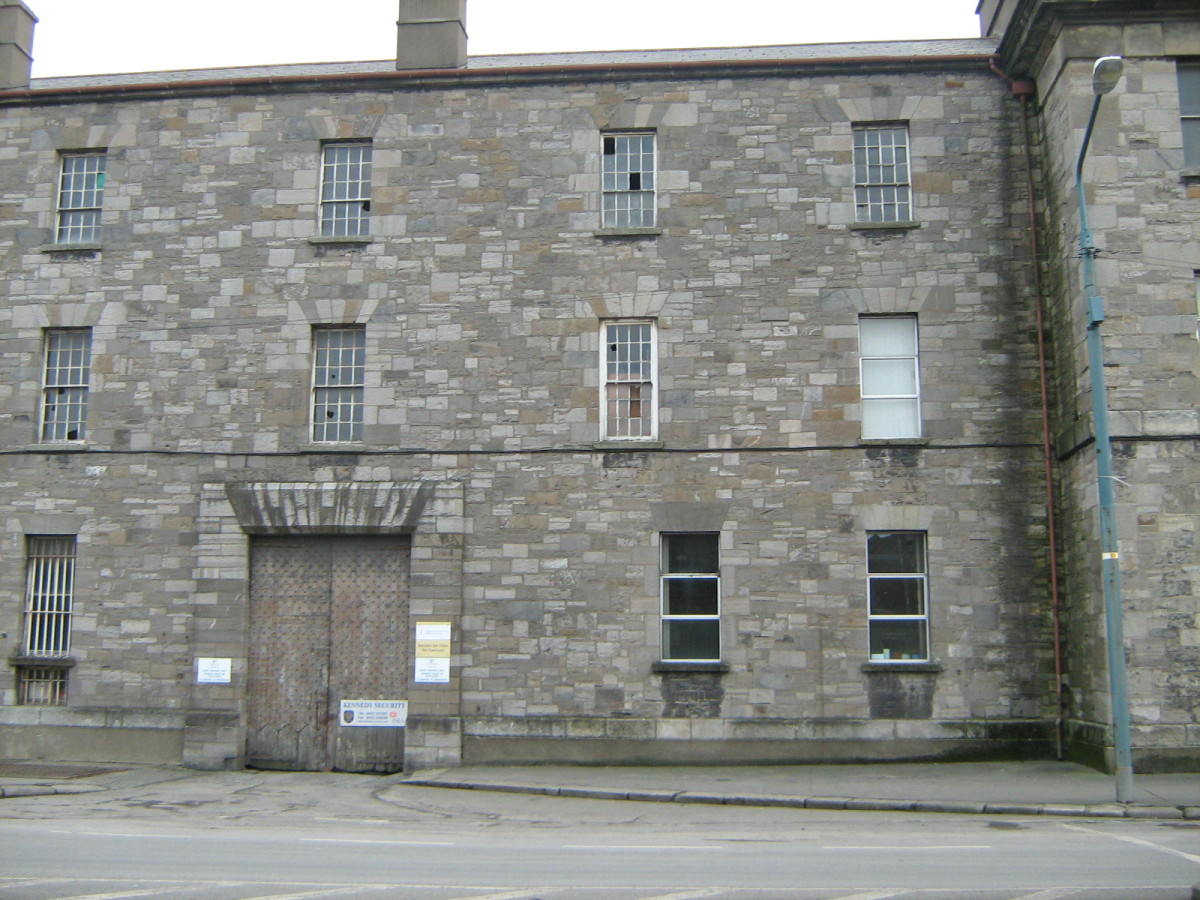

Irish Convicts Transported  Australia
hubpages.com/education/Grangegorman-Female-Penitentiary-Stoneybatter-Dublin-7-female-convicts-transportation-to-Australia

Grangegorman Prison, Dublin


 I’m fascinated how we love to make connections. You see it on ‘Who Do You Think You Are’ all the time. The famous guest looks back and discovers a connection. They discover an ancestor who was in theatre, was artistic, or something else that reaching back through time connects them.  Is it real genetic fabric, or is it conformation bias, I don’t know, but when I discovered Eliza stole twelve yards of calico, I was excited. A woman after my own heart. 
It probably had nothing what so ever to do with the fabric. She was probably desperate to feed her children and could resell the calico.


Upon arrival registers and reports were made and the equivalent of today’s mug shot was recorded detailing physical characteristics. Eliza’s description list states she was a short woman, 4/9”, age 24, fresh faced with very dark brown hair, black eyebrows, dark blue eyes and thick lips. She stuttered and had a scar in her forehead.[5]
Eliza’s conduct record states she was transported for Larceny. Gaol Report, ‘well behaved widow’. She stated her offence, Shoplifting 2 or 3 times. ‘Quiet and well behaved’. [6]


Eliza’s Indent record states she had only one child with her on the journey.[7] There was no definite policy on the transportation of children at the time, but outcomes followed were usually the ones that were cheapest for the government, and transportation of children with their mothers was the cheaper option.[8] Eliza’s children were admitted to an orphanage while their mother served her sentence. Emily Rose, presumably the child listed as accompanying Eliza on the voyage, was admitted to the Queen’s Orphan School on the 20th December 1842 at age 4 years, five days after arrival of the Waverley. Life at the orphanage in New Town was bleak. It was effectively a prison, with the crime either being born to a convict or the loss of a parent. Much like the convict stain, there was a stigma attached to being in the Orphanage. Children were abused, malnourished and treated badly and deaths common. The years 1841-1844 were particularly bad, with many deaths recorded. [9]
                         Queens Orphan Asylum New Town, 1863, courtesy of Tasmanian Images: Tasmanian Archive and Heritage Office

 Eliza had three children, but with only one documented as accompanying her on the Waverley, the records of herother children are a little confusing. Her son James was admitted to the Orphanage in 1841. Considering Eliza with the Waverley arrived in 1842, James’ childhood is unknown. Her other daughter Amelia also spent time at the Orphanage, admitted in 1846 at age six, her whereabouts during the previous four years, also unclear.[10]
Eliza was reprimanded for disorderly conduct in Liverpool St in December 1843. By June the following year she was marked as 3 Class. However, announcements from the Comptroller-General’s Office, December 21, 1844 were pleased to grant tickets-of-leave to ninety-five convicts, including Eliza. [11]


These often were granted before the sentence end, as convicts with a ticket could then earn their own money and become less strain on the Government’s purse. [12]
On the 1st September 1845, Eliza’s conduct record states her being in bed with a T. (ticket) of Leave man and she was sentenced to two months of hard labour at the Cascades Female Factory. Her son Charles was born at the Female Factory two months later, on 1st November 1845. [13]
Charles must have stayed with his mother as there is no record of him at the Orphanage. Presumably Eliza stayed out of trouble over the next few years as her other children survived their Orphanage years and were released to her. Convict John Williams and Eliza applied for marriage permission twice in 1849 but it was refused both times.[14]


Eliza was granted her certificate of freedom on 13th September 1852, almost ten years after her arrival, and finally in November 1852, John and Eliza were married at the “light on the hill” church, St Georges.
This church sits on the highest point of Battery Point and is also known as the mariner’s church. Appropriately, John was a shipwright.  John Williams was 49 and Eliza an understated 30. [15]


Watercolour by henry Grant Lloyd, 1848
Digitised item from: Allport Library and Museum of Fine Arts, Tasmanian Archive and Heritage Office

 Presumably their prospects were now better than ever, and they were happy to be building a new life for themselves in their antipodean home. They registered the birth of their first child, a male, in August 1853. John and Eliza were then living at Stoney Steps, a stone’s throw from the Female Factory, quite a way out of the town of Hobart.


                                                       View from Stoney Steps.                     National Library of Australia   nla.pic-an8368182-v

Sadly, after all the high-risk ordeals she had endured, Eliza died twenty days later. Cause of death was listed as influenza, but almost certainly her recent childbirth would have contributed to her death.[16] Another twenty days later their baby, now named Samuel Peter died too.[17]
Eliza’s short life left her legacy in her children and grandchildren who settled in the Huon Valley. Who raised Eliza’s children isn’t known. Once James and Emily left the Orphanage, I’ve found no records of them.  Amelia married convict Andrew Lumsden. Her surname had by then become Williams, perhaps her stepfather raised her. Perhaps he remarried. She and Andrew had at least six children. Charles Rose married Elizabeth Lovell had at least twelve children.  [18]  Charles was my maternal grandmother’s grandfather.

I visited Stoney Steps in Hobart. Now well and truly encompassed by the city, it is a tiny little lane at the end of Davey Street with a fabulous view. An old sandstone cottage on the left could easily have been where Eliza lived and died, or perhaps there was an old house up the old stone wall and steps at number 3.


Eliza's descendants populated and built the colony, started businesses, planted fields of apples and sent their sons and grandsons back to the other side of the world to defend their country. They pushed their convict forebears to the back of the closet and conveniently denied them.
Our UTas lecturer recommended a trip back to Ireland if any students had Irish ancestors. Hmmm, I must do that.


[1] “Sources in the National Archives for research into the transportation of Irish convicts to Aus 1791-1853”Rena Lohan, Archivist, Nat Archives Journal of the Irish Society, Spring 1996
[2] Discovery.nationalarchives.gov.uk/details/record>catid=5039006&catln=6
[5] Linctas.ent.sirsidynix.net.au/client/en_AU/all/search/results?qu=eliza&qu=rose
[6] Search.archives.tas.gov
[7] Linc tas names search convicts
[8] Convict Lives: Women at Cascades female factory/Female Convicts Research Centre Convict Women’s press 2012
[9] www.orphanschool.org.au/suffer.php
[10] www.orphanschool.org.au/listorphans.php
[11] Trove.nla.gov.au Colonial Times 28 December 1844 news article8755874
[12] Colonial Times28Dec1844 nla.gov.au/nla.news-article8755874
[13] www.femaleconvicts.org.au/docs/lists/ChildrenUnderSentence.pdf
[14]linctas.ent.sirsidynix.net.au/client/en_AU/names/search/results?qu=eliza&qu=rose&qf=NI_INDEX%09Record+type%09Marriage+Permissions%09Marriage+Permissions accessed 5 May 2018
[15] linc tas name search marriages
[16] linc tas name search deaths
[17] linc tas.name search deaths
[18] linc tas name search marriages/births

Saturday, June 2, 2018

The Convict Trail. Part I

Eight weeks ago I knew I had one convict ancestor, so I happily enrolled in the UTas Convict unit knowing I'd have someone to research.
I pulled out my unorganised records and found the little information I had on him. Martin Cupit, my maternal Grandmother's grandfather. On scanning my records, I spy a mention that her (my grandmother) other grandfather was born at the Cascade Female Factory. Presumably this means his mother was a convict and it starts me on my search for his mother, Eliza Rose.

Just to put her in a little context, Eliza was one of the 12,500 female convicts transported to Van Diemen's Land in 1803 to 1853. Approx half of these women were Irish.

These women were tried in Ireland and shipped off to the other side of the world, often with one or two children in tow. Once docked in Hobart, the women were disembarked and they were trekked on foot, early in the morning ( to avoid mixing with the respectable locals) the few miles to the Female Factory, which was situated quite nicely out of town under the shadow of the mountain by the rivulet. Here they were processed, set to work and had their children taken from them. The children were sent to the Queen's orphanage in New Town. For many, it would be unlikely they would ever be reunited.

                                                            iccs.arts.utas.edu.au/colonial/old_caia_site/femalefactory.html

For many Tasmanians, like me, its difficult to remove yourself from the sterotype and almost caricature of the convict. We grew up in the era when the convict stain was lifting from the fabric of our families' stories. We would pull the dirty linen from the closet and wear it as a bit of a badge of honour to state we had a convict in our past, but having very little understanding of what this really meant.
                                      Convicts in New Holland 1793  Wikipedia convicts in Australia

For a start, our fixation was often with the crime they committed. Seemingly menial crimes, like stealing an egg or a potato. In reality, the crime was irrelevant. Basically it was a deal. Their government wanted to get rid of a problem- horrific social conditions, starvation, poverty and the human cost that comes with this; our government wanted slave labour to build the new colony and consequently women to redress the gender imbalance that this virtual slave trade created.

Back to Eliza. Eliza arrived in Hobart on 15 December 1842 on the Waverley. On processing and the beginning of her record, it states she had one child with her. Five days later that child, Emily, age 4 is admitted to the Orphanage. I can't imagine the horror and heartbreak of saying goodbye to your child in such a way. And for the children, the trauma of maternal deprivation and subsequent institutionalization in such a dreadful place as this.

                                                                                                                                        linc tas

"There were 463 children at the institution, of whom 411 were the children of convicts and seven were Aboriginal. Reports indicate that conditions within the school were harsh: the buildings were sparsely furnished and cold; food was often in short supply; and many of those responsible for caring for the children treated them harshly. Epidemics of scarlet fever, measles , whooping cough and scarletina exacted a heavy toll amoung the children in the Orphan School."


Orphan School                     source ABC.net.au

Eliza had three children. I cannot unravel their stories. James Rose, 3yrs 6 mnths,  was admitted to the Orphanage on 17th August 1841 and discharged 13 December 1841. Considering Eliza arrived in 1842, this is confusing. Amelia Rose, 6 yrs, was admitted 3 March 1846 and discharged 27 July 1847. Emily Rose was discharged 24 April 1845. Records state all three were discharged to their mother. Obviously the children all had different fates, I can only hope they all ended up back with their mother at some stage.

Eliza was probably in some sort of service when she conceived her fourth child. The father's identity and the circumstances can never be known. Her record shows a few misdemeanors (more in Part II ), but back to the female factory for her to have her baby. After her final punishment of the crime of 'getting pregnant' she was a Class 3 inmate, the worst, and was sentenced to heavy labour, the bleakest corner of the Factory where the solitary cells and the wash yard were placed. The women washed and ironed for themselves, the staff and the citizens of Hobart. This meant carting water, heating it, scrubbing the heavy clothes, drying and heating and handling the heavy irons. How they dried the clothes through winter is a mystery.

                                                                                                                  female factory.org.au

The Factory is a fascinating place to visit. The day I went was sunny but cold. I wasn't sure where it was and I ended up following a rubbish truck. This was my first clue that I was in the right place and the history of the factory. Situated at the Hobart Tip, indicative of the attitude of the then society's wishes as to how to deal with these women. They were the lowest of the low and its taken many years to lift the social amnesia and banishment of these women from our memories and stories. Not only were they banished from their homeland, but then banished from their families stories and memory. These women were the mothers and founders of thousands and thousands of Tasmanians and Australians who built our heritage. The site of the factory had been forgotten and gradually degraded over the decades until it was saved from complete demolition in the 1960's by the National Council of Women of Tas. It had been the "ultimate act of erasing the suffering of convict women from the historical record" to quote Christina Henri.
The death of 1148 babies between 1829-1856 who are buried somewhere under a road outside the factory, inspired Christina Henri to start her baby bonnet project which grew into the Roses from the Heart project which aims to commemorate every convict woman with a replica bonnet.

Needless to say, now I know more of Eliza's life, I will be making her a bonnet.


                                      .
                                                                                               a sea of bonnets: Sew Make Believe.wordpress.com
 References:
linc tas names search/convicts
Female Convicts Research Centre Inc
Friends of the Orphan School    orphanschool.org.au
Christina Henri. Redeeming Memories a visual investigation into the lives of convict women

Wednesday, April 18, 2018

WW1 Part 3.


Another soldier's story.

Charles and Mary Rose were also to lose a grandson to the Great War. Their daughter Kezia, was seventeen or so years older than her brothers, the two Charlies (part 1 & 2).  Kezia married William Edward Cupit in 1895, and their first son was David. The two Charlies were still young boys when their nephew David was born.

Life sounds quite idyllic for a childhood in the Huon Valley in the early part of the 1900’s where the Cupit children grew up. Eldest daughter Ada, was followed by Kezia and William's two more sons, Martin and Albert (Top), then twin daughters Corrie and Ivy with Rene shortly after. Bill, Dick and Slim completed the family. Confusingly for family researchers, this family did not adopt the usage of their often very unusual given names but reverted to either nick names or shortened second or third names. 

A chronological search of the name Cupit in the Huon Times newspaper, reveals William running a Grocer’s store at Franklin, and the children all growing up in an extremely community minded district. The girls did well in the local school, Franklin State School, graduated to Secondary School and contributed in local concerts, fairs and organized social events. The boys dominate the newspaper reports however with their sporting participation. David, the eldest, appears first. He is playing hockey, rifle shooting, playing football and cricket. As the other boys get older, we see the majority of the over one thousand newspaper entries are sporting based. Boxing, rowing, swimming, cricket, football, badminton, cycling and yachting.
                                                   Franklin main street circa 1912 original online source unknown (pintrest)

David must have been a bit of a goer, as in October1913 he was one of the fifty-four car owners to register their cars in the state that month. He must have been one of the few car owners in Franklin at the time. He drove for the local doctor, Dr Anderson. In September 1913, he was booked and fined, not for driving an unregistered vehicle, but for having driven a motor vehicle without lights. As soon as he was old enough, David enlisted for service. In 1916, he left home:

Private D Cupit, who was home in Franklin for a few hours on final leave on Monday prior to leaving Hobart shortly with the engineers, was the recipient of numerous presents from friends, employers, fellow workers. Mr W.J. Thomas presented him with a beautiful wristlet watch and case, and amongst other articles he received a combination camp knife set, a balaclava cap and yesterday Mr Kennedy, his late employer, presented Private Cupit with a cheque, and also on behalf of the employers of the Franklin Exchange Stores with a soldier’s full-cased fountain pen. In making the presentation Mr Kennedy said there was no more popular young man in Franklin than Dave, and deservedly so, for he was willing and obliging to a degree to assist in anything going on. He would be greatly missed by one and all in the town. He was a promising cricketer and footballer, and his companions and acquaintances felt proud when they heard of his enlistment and acceptance, after so many trials to get into camp. He would be sure to give good account of himself wherever placed and trusted he would be spared to come back safe with honors which they all felt sure he would deserve.[1]

Dave was engaged to local girl Charlotte Coleman (Lottie). No doubt she would have been there that day as Dave farewelled his friends and family. When David enlisted for service, he stated his occupation as a driver and was utilized for this purpose. 

The local paper regularly published a Roll of Honour and listed soldiers who had gone to the front. Dave was to spend about fifteen months away from his home town before his return.

On Monday the 17th of February, 1918, Dave Cupit, Sergt V. Gallaghaer and Pvt Hunt were welcomed home by a large gathering of friends outside the Franklin Town Hall. Councilor Griggs said a few words on behalf of the crowd and wished the men a bright and prosperous future.[2] 

A few days later a night of entertainment was held at the hall. Songs, speakers and musical items added to the pleasure of the evening that ended with dancing. It must have been difficult for the boys to begin to slot back into their old lives.
Dave did, happily, return home but not to the bright future Mr. Griggs had hoped. Dave would never again be the sport loving and healthy young man who was planning a future with Lottie that he once was. 
Dave had been gassed and had TB. By the 1st of July 1918, a Welcome Home Committee was formed in Franklin. By 1920 the committee had a balance of £82 in their kitty when it was decided to divide the funds between Pvts A Fulton, L. Wicks and Driver Cupit.[3] The local ladies also gave Dave a travel bag as his brother Top, took Dave to South Australia thinking the climate might improve his health, but it was obviously no help as Dave and Top were to return. Lottie became part of the Cupit family, helping them to nurse Dave till he died in 1926 at age 30. She lived until she was seventy-three and never married. Family members recall that Lottie would weep whenever she saw Ivy, Dave’s sister, perhaps they were alike.


Obituary
Mr David Cupit, son of Mrs and the late Wm. Cupit, of Franklin, dies at his sister’s residence, Gordon, on Wednesday morning. Deceased was, prior to the war a popular member of the Franklin Football and cricket club. He was one of the first to answer the call for volunteers to the war and spent three strenuous years on active service. Unfortunately, he was one of the victims of that cruel method of warfare- gassing, and was invalided home a physical wreck. He had an indomitable spirit, and though his lungs had both been severely affected he fought hard to regain his strength and at brief intervals surprised even his medical advisers at the apparent progress he was making. The strain however at last became too great and a few weeks ago he had to take to bed and never rallied. He suffered considerably during the last stages of his illness. The funeral took place at Castle Forbes Bay cemetery this afternoon in the presence of a very large following of his former associates who deeply mourned the loss of a generous hearted companion. Many beautiful wreaths were placed on the grave as tokens of affection, including one from the Franklin Football Club. “The Last Post” was sounded by Bandmaster W. Vincent and no soldier on the battlefield better deserved the tribute. Deceased was in his 31st year. He was unmarried.


In the earlier decades of the 1900’s, steamers provided daily transport for the southern waters and areas of Bruny Island, The Channel ports, Hobart and Huon. It was one of these steamers the SS Excella that transported Dave Cupit on his final journey.
His funeral began on a Friday afternoon on the arrival of the SS Excella to Jackson’s Point. The boat left at 3:30, headed up the Huon River to Castle Forbes Bay Cemetery. David had died at his sister Ada’s home at Gordon.[4]

                                                                                                   SS Excella online source unknown


It would have been a much longer route to travel by road from Gordon, north, up through
Cygnet to Huonville where a bridge crossed the river.
The road then headed south again down through David’s hometown of Franklin and on to Castle Forbes Bay. SS Excella had a reputation as being a slow steamer, a bit of a plodder, but she did the job of transporting David and his mourners to his final resting place.

Charles and Mary Rose both reached old age in their hometown of Dover, Tasmania. Mary died in 1924, from accidental drowning at age 74. Charles snr died two years later at age 81, six months before David’s death.

                                                                 Photos Arthur Garland www.monumentaustralia.org.au

The Port Esperance Soldier’s War Memorial was unveiled by the Governor Lord Allardyce on the 21st May, 1921. A local committee had been working for some time to raise sufficient funds for a memorial to honour the brave lads who gave their lives. Out of the forty men who left Port Esperance to serve, twenty lost their lives and are memorialized on this monument.[5] The impact on this small community must have been catastrophic. Every family would have been affected. For Mary and Charles it touched two generations of their family.
 While Dave Cupit's name is not memorialized here with his Uncle Charlie (L.C.G. Rose), he is remembered as one of Franklin's boys who gave their life in this war. 


[1] Huon Times Tues 2 May 1916
[2] 1919 'FRANKLIN RETURNED SOLDIERS', Huon Times (Franklin, Tas. : 1910 - 1933), 18 February, p. 2. , viewed 16 Mar 2018, http://nla.gov.au/nla.news-article135716302
[3] 1920 'FRANKLIN WELCOME HOME COMMITTEE', Huon Times (Franklin, Tas. : 1910 - 1933), 23 April, p. 2. , viewed 16 Mar 2018, http://nla.gov.au/nla.news-article140943804
[4] Huon Times Fri 6 August 1926 trove.nla.gov.au  accessed 3 March 2018
[5]http://monumentaustralia.org.au/themes/conflict/multiple/display/70227-port-esperance-soldiers%60-memorial/

Sunday, April 8, 2018

Shoes of Magnet Town


One of our sons face-timed his dad for his birthday, but we were in the car on our way to Waratah for the weekend.
"I hope you've got a good book" he chuckled. Oh dear, the boys been out of Tasmania too long.

Waratah:
Well, actually, a weekend wasn't long enough. We missed the Athenaeum Hall, the museum, the Philosophers hut, the church/gallery, the cemetery and the walk to the old 1890's hydro power scheme site. Our intention this trip was to go to Magnet, the old silver lead mining town a few miles down the road from Waratah. We booked in to the Bischoff Hotel.

Having recently read Jewelled Nights, a novel written by celebrated author Marie Bjelke-Petersen, I was chuffed to be staying in Room 9 , a room with a perfect view of the town.


 In Marie's book, chief protagonist Dick/ Elaine Fleetwood stayed here in a room overlooking the township and waterfall of Waratah while dealing with the heartache of being in love with a man who thought she was a man, and who obviously had feelings for her, even as a man, but really she was a woman cross dressing and mining for osmiridium. Confusing.
Marie herself stayed here while doing her meticulous research for the book. The book was later made into a film, shot on site near Savage River and starring the lovely Louise Lovely, former Tasmanian, but then Hollywood, starlet.

photo:National Film and Sound Archive Australia
Louise Lovely's character Elaine Fleetwood, masquerading as Dick Fleetwood.


But, back to Waratah, actually,back to Magnet. My Dad started going there in the 1980's on little fossicking expeditions. We used to go down with him occasionally with four wheeled motorbikes and explore the old town. One trip he brought back a little kiddies boot, it sat on his bookshelf for many years. It would be about one hundred years old.

Magnet: 

You need a good imagination to believe that a town with such facilities that history and photos attest to, existed here in this pretty wooded valley where a creek bubbles and winds through a lovely wilderness of myrtle, sassafras, man fern all covered in soft green moss. It doesn't take long to see plenty of clues though.
Underfoot and littered down the valley are old bottles of all colours and variety (a lot of grog), old bricks, building materials and leather, soles and bits of shoes. And then for the observant, theres trees and plants that don't belong. The first one is an old holly tree that stands in what was the town centre right near the bridge. It has gone strangely feral. Perhaps through being eaten by wallabies, its more like a thicket than a tree, with an umbrella structure and leaves that have all but lost their spiky profile. There are a few palm trees, a daisy bush and a quince bush dropping its sparce load of severely underdeveloped fruit. The willows follow the creek, but are sparce, distorted into strange shapes and haven't choked the creek like they do in other Tasmanian waterways.
 Further down the valley conifers tower above the natural tree line. This was where the school was. These pines, including a Canadian Redwood, were planted commemoratively. Walking up through the conifers, its impossible to imagine a fine school house, thirty or forty neatly dressed children and their teacher, who was housed in the school master's house nearby. The outline of the stone foundation of both the school house and the toilet blocks can be seen in what looks like a site that should be preserved by the Time Team. If you bush bash up the slopes on either side of the valley, the flattened areas that were once house sites can be made out with steps, foundations, water pipes.....
 ......old buckets
......and even a finely preserved set of old boots sitting there as if  the miner came home from work one night, took his shoes off at the door and never came back for them.

I'd booked a tour with Tarkine Magnet Tours. Even though I'd been to Magnet quite a few times, this was a wonderful tour. Paul, the guide, knows details of the town's history, has old photos and shows us tourists the sites of the churches, the school, the hospital, the hotel and the tennis court, and happily shares his stories with the punters.
                                                        Magnet Boarding House: source online, unavailable site
town centre and bridge photo: www.miningmayhem.com.au
Magnet Catholic Church. Source tasmanianpioneers.com:Weekly Courier,linc


I would thoroughly recommend this tour to everyone, worth every dollar and every minute. But lets just keep it between ourselves because we don't want the masses to discover our special, secret places ;) 

I'm left with questions about Magnet, the main one being why did they leave behind so many shoes?

Thursday, March 29, 2018

WW1, The ANZACs: Part 2


The Daisy Patch, Gallipoli

On the Gallipoli Peninsula there was an open field, covered in long stemmed white daisies interspersed with red field poppies. This description belies the Hell that happened there nearly 103 years ago. Writing and researching my great Uncle Charlie's war has been an incredibly emotional experience, learning about the events that took place there in 1915. I cried as I found each new piece of the harrowing account of  the 8th of May 1915, the day Charlie Rose died  in Gallipoli. 


                                                              Soldier Profile: 

 Charlie Rose’s World War 1 role was a short nine months in its duration. It began with his smeared signature on his recruitment form at Ngahere, New Zealand on the 13th August 1914, and ended with his death at the Dardanelles on May 8th, 1915.

Charlie’s father, Charles Rose signed his 1868 marriage document with an X. His bride was Mary Lovell. They began their family of at least fourteen children with the birth of Kezia in 1869. Charles snr was a labourer, carpenter, bushman and farmer. Luther Charles Garnet (Charlie) was their fifth son.He and his siblings grew up in the town of Dover in Tasmania.
Charlie presented himself for enlistment within the first week of the mobilization at the outbreak of war. Charlie had relocated to New Zealand, enlisted there and was assigned to the 1st Canterbury Battalion, 13th Company, NZEF. Charlie’s occupation was a bushman. Charlie would no doubt have been a fit, able bodied and capable young man, confident in risky and physically challenging situations.

Training began at Addington, near Christchurch, and equipment was issued to the men as quickly as it became available. Every man was keen, as he realized that if he failed to reach the required standard, there were dozens of men anxiously waiting to take his place.
Presumably, an unmarried and capable young man like Charlie, was keen to embark on an adventure like this.  On October 16th, Charlie boarded the Atltentic in Wellington Harbour and two escort ships lead a fleet of thirteen ships into the Tasman Sea.
On the 21st, the fleet called in to Hobart. Troops disembarked for a route march.. Briefly back on his home ground, was he able to contact or see his family? Did Charles and Mary know their son had enlisted?
The Australian transports joined them at Albany when they reached there on the 28th. This now formed a large and imposing fleet.

Charlie and the men on board spent their time in military exercises and organized amusements. Food was reportedly good. Before breakfast there was physical training, lectures, musketry, rifle exercises, and as much drill as the limited space allowed.

When the fleet arrived at Suez, orders were received that the Australians and NZEF would not be going on to France as expected. They were to complete their training in Egypt. The NZEF were camped at Zeitoun, four miles out of Cairo. Here the men worked on their drill, field training, route marches, night work and entrenching practices in their makeshift, sandy and dirty camp. By the end of January, Auckland and Canterbury Battalions were sent to Ismalia, half way between Port Said and Suez to defend the Suez against advancing Turks. After a successful three-day attack, fighting ceased and Canterbury remained there training and manning the area until they were shipped back to Zeitoun in late February.

Charlie and the 12th and 13th Company men arrived at Anzac Cove at 5 pm on April 25. Each soldier carried weaponry, water bottle, entrenching tool, haversack and a pack containing 30 kg of rations, water, firewood and clothing. They were immediately dispatched to Walker’s Ridge. The night was spent under infantry attacks and heavy fire. The enemy was invisible to them and the men were launched into the complete confusion of an unknown and difficult landscape. For the first day alone, Canterbury had 198 casualties, 21 dead, 87 wounded and 100 missing, an indication of the desperate nature of fighting conditions that the men were suddenly and chaotically thrown into.

The next two weeks were spent in the less than four square miles of their occupied area. With about 25,000 men in such a small space, conditions were harsh. Charlie and his mates had a staple diet of tinned bully beef, army biscuits and jam.

“Bully beef and biscuits. You couldn’t eat your biscuits dry. It was like chewing rock. You had to soak it. For pudding we used to have biscuit soaking in water and the jam all mixed up together.”

Conditions warmed up with the approach of summer. Overflowing latrines, body lice, disease, flies, unburied dead and a steady stream of enemy fire and casualties made physical and psychological conditions increasingly difficult. On the 8th of May the New Zealanders moved into an attack on a piece of ground named “The Daisy Patch”. This would also become known as the “Gardens of Hell.”
The Daisy Patch was an open field, totally devoid of cover and was overgrown with the common red field poppy and thick long-stemmed white daisies.

“I watched the 12th Nelson Company make an advance over open country called the Daisy Patch. There was absolutely no cover for them. They lost their commanding officer……Our turn to go across came next, and we went over the top in good order, with the best of luck. At once we were greeted with a terrible fusillade of rifle and machine gun fire…..the man on my right had his brains shot out into his face, and the chap on my left was shot through the stomach”, Bill Leadly remembered.

All day advancements were unsuccessfully attempted. Charlie Rose’s death occurred on the 8th of May. Charlie was one of the young Canterbury Battalion men just like the ones who died next to Bill Leadley that day at the battle for the Daisy Patch. That night was a rainy one and many men were wounded and had to spend the night on the battlefield, as evacuations were impossible.  Two hundred Canterbury men were killed, wounded or missing that day on the Daisy Patch.
The following morning was fine. Reinforcements arrived that evening and burial parties were sent out at dusk when all the dead within reach were buried. Fir Tree Wood was the small cemetery where Charlie and his fellow New Zealanders were buried when the opportunity had presented. On May 24, an armistice was declared. The day broke with a steady drizzle the allies mingled freely with “Johnny Turk” on ‘one of the strangest days of the campaign’. Thousands were buried as chaplains searched for identity discs and read burial services. Conditions made order and appropriate burial impossible. Charlie’s final grave is at Twelve Tree Copse. There are 2226 unidentified burials here. Charlie is commemorated here as one of the six Australians who fought with the New Zealand forces along side the 179 names from the NZEF Battalions most of whom were killed at the Daisy Patch on the 8th of May.
News of Charlie’s death didn’t hit home for several months. A local NZ newspaper announced in August:

“Private advice states that Pvt Charles Rose……. was killed in action at the Dardanelles on May 8th. The deceased was very popular in the Ngahere district, where he worked for Mr John Wright, sawmiller. He was 26 years of age, a good hearted man, took a great interest in chopping, athletic events, and was a prominent footballer.”

Charlie’s death notice appeared in local Tasmanian papers in August too. Handwritten family records recall this event many years later:

“She could still see her mother’s face (Kezia) when she was told of her brothers Charlie's... death, killed in WW1. She was weeping.”

In November the family received a letter from the New Zealand exchange from Charlie’s mate.
“I was very fortunate in only getting wounded, as the whole air was a mass of lead; but it is not about myself I am writing this. It is about poor old Charley Rose. Charley was the best friend I had in the army. He was with me always, in gay times and hard times, ever since we joined in August of last year: but he is dead now, and I deem it my duty to write to you. Though I miss him very much, and you and your family miss him too, we have this one consolation- he died like a real soldier. He faced the shell, bullet and bayonet for thirteen days. During that time he showed splendid courage and only a few minutes prior to his death when we were all in a hollow preparing to rush across an open patch, which was literally swept with lead, even as we sprang out of the hollow into this leaded hell. I heard Charlie laugh and give a cheer- alas his last laugh, his last cheer. We had to run about 200 yards to reach our next position such as it was- a mere rising in the ground, hardly sufficient to cover our heads. Indeed about 26 were killed while we lay under this cover, and this in less than five minutes. We rushed across the hill in sections of about 12 or 14 men. My section had only started when I saw two of my comrades fall, one along side me, the other about two yards away. Then Charley fell, he just dropped to his knees, his head sank, and he rolled over stone dead. He never spoke a word or uttered a cry. He just rolled over and I knew what that sign meant. It was indeed a fearful sight, made hideous by the cries and groans and curses of the wounded, but there is no need to dwell on these things. Poor old Cummings fell the day after we landed, and ‘Bumper’ Smith was killed the same day as Charley. The weather here in Egypt is fearfully hot, quite the hottest I have felt anywhere. I believe we are going back to Gallipoli on Wednesday. I could stay until the next boat, but it wouldn’t be fair, as I am fit enough to scrap again, and every man is needed there.”

 As well as at Twelve Tree Copse, L.C.G. Rose is memorialized on the Port Esperance Soldier’s Memorial and the Greymouth War Memorial in New Zealand. 


[1] discoveringanzacs.naa.gov.au/browse/records/551762/2
[3]www,linctas.ent.sirsidynix.net.au/client/en_AU/all/search/detailnonmodal/ent:$002f$002fNAME_INDEXES$002f0$002fNAME_INDEXES:1072033/one?qu=nalta&qu=rose accessed 20 Feb 2018
[4] www. discoveringanzacs.naa.gov.au/browse/records/551762/2 and 571694/1 accessed 2/2/2018
[5] The History of the Canterbury Regiment, N.Z.E.F. by Captain David Ferguson Witcombe $ Tombs Limited, 1921. New Zealand Ekectronic Text Collection
[7] Russell Weir, Wellington Battalion, in Jane Tolerton, An Awfully Big Adventure: New Zealand World War One veterans tell their stories, 2013
[8]Walter (Bill )leadley of the Canterbury Battalion Gavin McLean, Ian McGibbon and Kynan Gentry (eds)The Penguin Book of New Zealanders at War, Penguin, Auckland 2009, p136

[9] The New Zealanders at Gallipoli, Fred Waite. Whitcombe and Tombs Limited 1919. New Zealand Electronic Text Collection
[10]Gallipoli, The Battlefield Guide Mat McLachlan Hachette UK 2015
[11] Gallipoli, The Pilgrimage Guide Garrie Hutchinson Black Ins 2007
[12] The War, Greymouth Evening Star, 10 August 1915 www. paperspast.natlib.govt.nz/newspapers
[13] Huon Times Saturday 7th Aug 1915 trove.nla.gov.au
[14] Joan Cupit, handwritten family memories and interviews. interview with Rene Tuck, daughter of Kezia Cupit, in possession of family member
[15] Huon Times 10 November 1915 trove.nla.gov.au accessed  8/3/2018
[16] http://monumentaustralia.org.au/themes/conflict/multiple/display/70227-port-esperance-soldiers%60-memorial/  accessed 5/3/2018

WW1, The ANZACs: Part 1


World War 1

My recent utas unit was called Families at War. For the last six weeks I have gone on a journey from not knowing if I had a family member who went to this war, to researching the life, service and post war life of several men in my family.

Like many of my generation,  my war history is woeful. The most I knew about Australians in WW1 was from the 1981 movie Gallipoli. As a then twenty year old I saw this at the cinema. A very young Mel Gibson and Mark Lee played the eighteen year old mates who went optimistically off to fight and ended up at Gallipoli. I cried and felt the shock and anger at the end when Archie Hamilton (Lee) was gunned down along with the hundreds of other young men. I think this movie may have been the start of a cultural turning point and awareness for my generation, whose lives had never been touched by war.

Through my lifetime ANZAC day services had declined and appeared to be dying out along with the ex servicemen who attended. When my own sons joined the Boy Scouts, we started attending. Through the 1990's, the services grew. Now twenty years on, an ANZAC Day service attracts more crowds than ever.

My personal soldier research began with searching the unorganised handwritten records I'd had in my genealogy stash for years.

                                                             Kezia Rose
Kezia was the eldest of  the large family of Charles and Mary Rose. She was born 1869 at Castle Forbes Bay
                                                           Corrie Cupit
Corrie Cupit was my maternal grandmother born 1902, daughter of Kezia and William Cupit, Franklin.

My search for a soldier to research I found in my maternal grandmother's family.
Mary and Charles Rose's eldest daughter was Kezia.
One of Kezia's daughters was Corrie, my grandmother. These photos would be about the right era for the onset of World War 1.

My records showed two of Kezia's brothers died at Gallipoli, Nathaniel and Luther.
Ahh, here's my start I naively think.

The two Charlies:

I trove through Trove, I trawl through Ancestry and I wade through the War Memorial. No luck.
As it turns out, the brothers had moved to New Zealand and enlisted there. Luther, known as Charlie, enlisted in 1914 within the first week of mobilisation with the NZEF, and he became my soldier profile for my assignment.
His brother Nalta enlisted in December 1915, also in New Zealand, most confusingly under the name of Charles Jackson.

                                                                                                              www.findagrave.com, posted by Judy Robinson

I was excited to find a photo of the Rose brothers on Ancestry, Charlie (Nalta) standing and Charlie (Luther) sitting. I haven't figured out when this would have been taken as their enlistment dates were a year apart.
Ancestry informed me of the death of their brother Frank in 1915 too. After much searching, a Frank Rose did die on the front, but not our Frank, a different family. Nathaniel Rose is still a mystery too. Perhaps the family records are confusing Nalta and Nathaniel?

Charles Jackson’s enlistment date was ten days before Christmas 1915. Charlie listed his next of kin as his mother in Tasmania. Conscription was not to be policy in New Zealand until 1916, but pressure to fight the ‘hun’ and protect loved ones was widespread. In 1916, New Zealand press coverage of the war was widespread, with dire predictions of the length of the war and headlines such as Every Man Wanted. Perhaps the loss of his brother compelled him also.

Charles stated he was a labourer under the employ of J. Gorson at Tuatapere. His foreign service in the 11th reinforcements, Otago Infantry Battalion D Company was to last three years and sixteen days, mostly in France until his return to Wellington in September 1919. His difficult to read war record shows Charles sustained some injuries and had illness, was transferred to varied duties and locations, but was to return home nine months after the official end of the War.

Charlie's (Nalta) life remains a mystery with conflicting records about who he married, no records of children or anything significant. he lived out the rest of his life in New Zealand, never reverting back to his real name, and died in Christchurch in 1959 leaving a wife, Mrs C.I. Jackson.

My next post tells Charlie's (Luther) story.


Thursday, August 3, 2017

The Nook


The Nook


As a recent UTas assessment I had to write a 750 word narrative. This is a small window into the lives of my gggrandparents Sandy and Christina Hamilton, of The Nook, Tasmania.


Image result for wesleyan methodist


“Church of England….Brethren…. Congregational,” Sandy Hamilton bellowed out in his thick Scottish brogue. As he listed the denominations, he noted the show of hands from the townsfolk who were gathered together on the site of their new church building.
“Wesleyan Methodist it is then,” he announced, as that was the denomination most represented by the neighbours who were gathered. That was to be their new church denomination.

 Sandy and his wife Christina were Scots Presbyterian.
They, like most of the districts pioneers, had arrived in Van Diemen’s Land nearly thirty years previously in the 1850’s, and had been hand-picked by ministers as being upstanding and strong Christian folk suitable to populate the far-flung colony. Many of them had left the British Isles because of famines, crofting clearances or perhaps just a wish for adventure.


Sandy and Christina had cleared the dense forest of their land, built a homestead and established a fine farm in the township of The Nook. Sandy must have foreseen the need for their own local church as he had donated the land and had helped the overseeing of the administration of the site.

                                                 Nook Church

The Nook was a pretty little corner of the Kentish district, flanked by a range of hills on one side and the Don River on the other. The roads in and out of the town were precarious and sometimes unpassable. The track to Latrobe passed through impenetrable forest. The roads were a constant topic of conversation and planning for Sandy and the other men on the Roads Trust Board. When Sandy and Christina first arrived at Nook with all their wordly possessions on a bullock dray, it was found that one child was missing! Upon backtracking, they found the lad waiting on the side of the track, he had no option, the bush was too dense to allow any alternatives.....or so the family story goes.
While access may have at times been problematic, the growing township was providing residents with their needs. The picturesque Nook Falls cascaded by the nearby flour mill.


 A school was constructed and was soon followed by the opening of a Post Office. 

From the window of her home, Christina could see over her picket fenced verandah, beyond the front paddock, to the church. As was common then, Christina had borne eleven children. As was less common, she had lost only one child in his infancy. Her bonnie lads and lassies had all attended the school and they participated eagerly in church activities.


                                                Hamilton Homestead


 She had a rare, quiet moment as she gazed over to the church. She had sent the younger children off to gather ferns. Tomorrow was the first Harvest Thanksgiving service at the church and she was helping the decoration of the interior with fruits, flowers and ferns. Her mind wandered back to her old church her parents attended in Ayeshire, half a world away. Her children would never grow up hearing fine Scottish Presbyterian prayers or thick renditions of Robbie Burns poems. She seldom let her thoughts run along old, forgotten paths. She could not afford time in wistfulness. She, and her peers, did not have the luxury to indulge in self-serving thoughts and divisions. They had put aside religious and theological division, class and cultural tradition. They needed to work together and support each other in what had often proved to be a difficult life. They had to baptise, solemnise, inter, worship and all sit under the same spiritual instruction together in that little chapel under the teaching of the Rev J.W. Edwards. Edwards was the newly appointed minister of the Sheffield circuit and his message tomorrow was to be The Harvest: The End of the World.  
Christina’s thoughts were abruptly halted when the children ran inside with armfuls of beautiful fern fronds they had gathered from the river gully. Christina helped the children with the ferns, took her basket of apples and pears gathered from the backyard orchard, and headed over to the church to join the other women.

When she arrived, the choir, which included her eldest girls Elizabeth, Mary and Jessie, were practicing their hymns and anthems for tomorrow’s service. Miss Bell was preparing children’s activities and Christina’s sons William, Jim and Tom with other local lads were helping to hang bunting and clean up after the ladies had trimmed and rejected some of the foliage and greenery.

It was April and the autumn was cooling. Sandy and Christina sat that evening by their fire. The days were growing shorter and The Nook, being a secluded hollow, could be cold and damp as the winter months came upon them.  
“The church looks mighty fine,” Sandy commented to Christina, “You ladies did a beautiful job.”
“We have plenty of reasons for thanksgiving,” Christina answered. The community had pulled together. Nook residents had a reputation for being unobtrusive and hospitable to a fault and the Hamiltons were a part of that founding group of brave and quietly achieving pioneers.      


Reflective Statement:

In this writing, I have tried to recreate a day in the lives of my Scottish GGGrandparents, Sandy and Christina Hamilton. Family anecdotes were always told about the Scotsman Sandy, but nothing was ever said about Christina.  I thoroughly enjoyed writing this and was thrilled to find much mention of the Nook Wesleyan Church in Trove newspapers.  The story of the choosing of the church’s denomination was told to me by Sandy’s grandson, so I cannot verify it. I have tried to stress the need our pioneer ancestors had to work together and put aside religious differences, and how important the function of a church was to them. Churches provided a means of coming together, entertainment, outlets for creativity, courting and marriage and support in deaths, regardless of an individual’s belief system. Sandy and Christina were to lose five of their adult children in the 1890’s, the next decade after the setting of this narrative.
Using one event, I have tried to bring the town of Nook and its landscape to life. Seven hundred and fifty words is a difficult task as there is so much more to say, but hopefully I’ve taken a snapshot, while still including some background context and some multi-generational information.
Writing this drew me into their world completely, so I really hope the reader may experience a little of that also.         

Bibliography

With The Pioneers, Charles Ramsay , Mercury-Walch, Hobart
Touring Tasmania in the 1880’s, the newspaper articles by Theophilus Jones transcribed by D.J.L. Archer
North West Post July 1909,  nla.gov.au
North Coast Standard, April 1894, trove.nla.gov.au
Conversation with Ross Hamilton  1989