Monday, October 22, 2018

Female Convict Health Assignment

Our last utas unit was one of the most challenging yet. Our final assignment was putting one convict in a greater context. I choose the topic of risks to convict health on the journey out to the Colony.

My previous research and blog on my ancestor, Mary Brien, had made me very curious about her mental health as her behaviour just seemed to reveal traces of depression, trauma and even bi-polar.

As I began my research into my chosen topic, having no idea whether I'd get anywhere close to assignment material, a fascinating insight into female convict mental health unfolded. Hysteria, as it was then called, was pretty rife, as you would indeed expect in such traumatic circumstances these women found themselves in. 

This essay discusses health risks of female convicts transported to Van Diemen’s Land between 1822 and 1853. The key aspect presented is that of mental health. Mental illness even today can be difficult to diagnose and quantify. The circumstances such as these convict women found themselves in, such as desperate social and economic conditions, imprisonment, exile and forced separation from their children, must have been fertile ground for anxiety, depression, trauma and to use an outdated term, a nervous breakdown.

An example of a typical convict was Mary Brien. Mary arrived in VDL on the Blackfriar in 1851, age 30, with her ten-year-old daughter. She was reported as being troublesome in the Irish prison but quiet on the voyage out. [i] Upon arrival her daughter was taken to the Orphanage, mother and daughter separated.[ii]  Mary is not mentioned by John Moody, the Surgeon Superintendent on the Blackfriar, so she obviously suffered no illness severe enough to be hospitalized or logged. Nevertheless, Mary’s subsequent life in the colony was not particularly trouble-free.
When Mary’s postings began, the first lasted less than two weeks. Mary was then shunted between Brickfields Hiring depot and the House of Correction five times until her second hiring a year later. It seems Mary’s first year didn’t go so smoothly. Examination of Mary’s record reveals a pattern. Each year for the next six years, she had short stints of hiring followed by more time at Brickfields, two court appearances and even more time at the House of Correction.[iii] Clearly, she was a difficult one. Mary was continually reprimanded, namely, for insolence, misconduct and neglect of duty. It seems Mary had an attitude problem. Was Mary just a fiery Irish woman, or did her mental and emotional issues run deeper?


                                                        portarthur.org.au


Evidence of convict women’s mental states after transportation is scant, and Mary’s mental state is speculation only, however evidence is prevalent as to the mental health of women such as Mary on the long voyage out. John Moody commented that it was not an easy thing to assess the physical and mental states of so many who have come to him from the confines of a difficult prison situation. With so many temperaments to manage, making on the spot diagnosis of mental health would have been impossible. It didn’t take too long before John Moody had a mental heath issue to deal with though. The night before sailing, John describes treating Catherine Walsh, a Lunatic who was lucid upon embarkation. As it was too late to disembark her, the poor girl was strait jacketed. Again, after two months at sea, he describes Anne Torpey, a ‘stout girl of nervous temperament’, one night jumping out of bed screaming and running about in a frantic state. She was hospitalized for several days.[iv]

                                        Surgeons reports give fascinating insight into the voyage out.    blogs.ancestry.com.au

The terminology used at the time, was Hysteria. By the 1800’s Hysteria was being seen by professionals as less of a disease of the uterus or demon possession, and more correctly as a mental condition. Symptoms described by these surgeons were seizure like paroxysms, fainting, irrational behavior and unresponsive and hyper responsive conditions, symptoms that would now be recognized as depression in all its forms, traumatic stress and anxiety.[v]
Indeed, on closer examination of Surgeon’s reports from female transportation ships, Hysteria pops up regularly. It had to be quite disruptive and severe to make a Hospital admission. Of these reports, some are brief and to the point, while others are extremely detailed and give fascinating insight to day to day life on board. Some Surgeons comment predominantly on weather, while others, conditions of cleanliness and routines of the women. Frequently Hysteria is listed on the summary only and some surgeons make mention of its prevalence only in their remarks written at the end of the voyage. Hence, cases of Hysteria were possibly far more common than is reported, as many needed no treatment.  


Surgeon Superintendent Charles Smith gives an insight into the psychological state of the Irish females in his charge. The Duke of Cornwall sailed in July 1850, immediately preceding the Blackfriar. Charles had a huge caseload of twenty-six cases of Hysteria to deal with. His opening remarks stated that the Irish were a highly susceptible race and that the women ‘suffered much from Grief and depression of Spirits at leaving their friends and native Country’. He states many of the women were not put on the sick list as their paroxysms were of short duration and their general health was good. He describes varied symptoms such as loss of power of speech, paralysis and ‘extravagant hallucinations’.[vi]

                                                                                                                                                                        ourfamilypast.com

In 1849 John Moody, then surgeon on the Lord Auckland, also refers to the spirits of the women on board. He treats them with ‘kindness, at the same time with firmness’ to restore their spirits, noting its no easy matter where Irish convicts are concerned.[vii] Surgeon A.F. Macleroy (Phoebe 1845) reports of seasickness, ‘accompanied as usual in females with Syncope <[fainting]> & Hysteria in various degrees & shapes, many cases being very troublesome tho’ not placed on the Sick List.’[viii] Surgeon James Clarke’s (Greenlaw 1844) general remarks comment almost entirely on food and diet, but he does generalize about the extreme mental depression of women on his Sick List and how this is generally the case amongst the lower and ignorant Irish class.[ix] Signs and symptoms of  mental suffering are also scattered throughout the English female ships, even with several suicide attempts mentioned.[x] Most Surgeons report they handle their cases successfully with treatments ranging from ‘constant employment’ to shaving the head and cold-water ablutions, blood-letting, enemas and various dosages of substances such as Submuriate of Mercury, aloetic pills and Laudanum.

  
                     Surgeon Superintendent James Hall on 4 ships 1820-1833, Aust Convict & Convict Ships Board, pintrest

Examination of sixty-four Surgeons reports of both Irish and English female ships which landed in VDL, twenty-nine made mention of one or more cases of Hysteria, an indication of the mental and emotional stress of women undertaking a voyage with incredible risks and uncertainties.[xi] Given the series of traumatic events these women endured, it would be highly likely that many of them would indeed have their mental health severely compromised. Likewise, the development of Post-Traumatic Stress Disorder would be a high possibility, hence affecting their ability to reintegrate successfully with an extremely high probability of developing alcohol dependence.[xii]

Mary Brien gained her freedom and married George Gray in 1859. [xiii]  Whether married life settled her, is also unknown, but in 1875 Mary Brien-ex-Gray, died a pauper in a residence on the corner of Molle and Golbourn Streets in Hobart.[xiv]
To conclude, that Mary Breen suffered from any ill mental health is pure conjecture. She had times of compliance and times of turbulence.  Why was she a difficult woman? Perhaps she suffered from mental illness and was damaged by a system which intended to force conformity, limit personal freedom and ‘reform’ the wild ones, but had little understanding of emotional and mental suffering, treatment and subsequent personal and societal cost.

                                                                                                                                convict love token   sydneylivingmuseum.com.au


[i] librariestas.ent.sirsidynix.net.au  NAME_INDEXES:1375061 accessed 8 August 2018
[ii] www.orphaneschool.org.au/show orphan accessed8 June 2018
[iii] Female convicts in VDL database, Female Convicts Research Centre Accessed 16 June 2018
[iv] www.femaleconvicts.org.au/convict-ships/convict-ship-records
[v] www.ncbi.nlm.nih.gov/pmc/articles/PMC3480686/ Women and Hysteria in the History of Mental Health accessed 1 Aug 2018
[vi] www.femaleconvicts.org.au/convict-ships/convict-ship-records
[vii] www.femaleconvicts.org.au/convict-ships/convict-ship-records
[viii] www.femaleconvicts.org.au/convict-ships/convict-ship-records
[ix] www.femaleconvicts.org.au/convict-ships/convict-ship-records
[x] www.femaleconvicts.org.au/convict-ships/convict-ship-records, Emma Eugenia1846, East London1843, Mary Ann 1822, Tasmania 1844
[xi] www.femaleconvicts.org.au/convict-ships/convict-ship-records
[xiii]librariestas.ent.sirsidynix.net.au   
[xiv] "Australia, Tasmania, Miscellaneous Records, 1829-2001," database with images, FamilySearch (Cemetery records > Burials and cremations, Cornelian Bay Cemetery > Feb 1875-Jul 1876, AF70/1/2 no 699-1186 > image 101 of 510; Tasmanian Archives and Heritage Office, Hobart. Accessed 20 July 2018

Tuesday, October 9, 2018

Mary Rose, a 'beautiful lady'.


Having begun on the convict trail that wends its interesting journey back through the family trees that are my heritage, I take another detour through the forest.


I've looked into three of my maternal grandmother's grandparents and been  amazed at what I've found. Her father William Cupit with his father Martin, the convict from Derbyshire, and her mother Kezia Rose with Kezia's father Charles Rose, son of an Irish female convict and being born in the Female Factory.

Then there's Martin's wife, Sarah Murphy, coming out on the ship at age 10 with her convict mother from Ireland. Finding such a rich and diverse heritage has widened my knowledge of Tasmanian history greatly. 

I knew my grandmother well. When I now look back, I realise how tangibly close our early colonial history really is. In our last Convict UTas unit, we heard one historian's tale of  her grandfather, who she remembers well too. When he was a lad, he witnessed the final day at Port Arthur when he watched the last convicts file out of the precinct in the mid 1870's. This colonial era was in living memory of living memory. I feel like I can almost touch the memories of these ancestors in  my own mind, particularly when we can visit so many intact sites in and around Hobart.


I was in Grade 4 when we celebrated the Bicentenary of Cook's 1770 landing. We learned the story at school and studied the convict system.


 "Nanna, do you have convicts in your family?" her curious 9 year old grandaughter asked. Nanna squirmed and told me that perhaps there might have been one way back and dropped the subject quickly. 
I now know this "one" was her grandfather Martin, goodness, she could have actually known the man. The "one" was also her grandmother's mother and her grandfather's mother. She was too close to them in history to have been free of the dreadful convict legacy- shame. Van Diemen's Land changed its name and did everything possible to hide that legacy. The convict sons and daughters became loyal subjects to Queen Victoria and a collective amnesia settled over the population like a heavy, silent blanket. Our convict sites were ignored, left to decay, and re-purposed.

My final research was with Nanna's maternal grandmother. Mary Rose was Charles Rose's wife. Nee Lovell, her mother was Elizabeth Smith. With a name like Smith, I had been putting this research off.

Turns out the Lovells have been hard too, there's an awful  lot of them.
Mary Lovell first appears when she marries Charles Rose at the home of John Smith, Castle Forbes Bay. Charles is 21 and Mary is 15, very young. Doing the maths, Mary was born 1853ish. Castle Forbes Bay is just south of Franklin. Its my, unsuccessful so far, aim to find out how and why my ancestors ended up in the Huon. By the early 1850's, farming was well established in Castle Forbes Bay, but it was in the timber industry that the work existed. Men came here to work and this is probably what drew Charles to the area where Mary was already living. The Victorian Gold Rush meant extremely high demand for timber, and this was coming from the Huon. Local papers advertised. In 1856 and 57 Dr Crowthe and James Scully advertised plenty of employment for sawyers, splitters and bushmen at Castle Forbes Bay.

Charles and Mary started their large family with Kezia born in 1869. Charles was a farmer at Castle Forbes Bay then. In 1871 he was a farmer/settler in Franklin and with each birth register he was a bushman, a labourer, a farmer or a carpenter at Fleurty's Point, still at CFB. So clearly life for the man of the house meant working at whatever you could when it was available.
By the 1890's when Mary and Charles had their last two children, they had relocated to Port Esperence. Lillian Lockley registered her youngest brother's birth and stated her mother's maiden name incorrectly as Smith. On registering her youngest sister's birth she called herself Mary Lockley. It seemed christian names were interchangeable. Indeed, most of her 11 siblings changed, shortened, misspelt and used their middle name. It seems Percy Rheuben ended up being Luther Charles Garnet known as Charley. And Nalta Rummond ended up Charlie Jackson (these are the WW1 stories in a previous blog). So while Charles was working, Mary was child rearing.


 two of the Rose sisters, Eva Christie born 1875, and 
Kezia Cupit born 1869


Charles and Mary  lived out their lives in Dover where the youngest of the children went to the local school. They had many grandchildren and happily lived to see them.

In her latter years, Mary Rose joined the Salvation Army, which was active in Dover early in the 1900's. 


A group of Salvo's, taken from A History of Dover & Port Esperence by Norm Beechy & Dorothy Baker. Seated 2nd from right is Harry Schnell. Harry was born in 1874, so this photo would be right for Mary's era, in fact, I'd hazard a guess that that could even be Mary standing on the right.

She and her youngest son Ted both became officers. A War Cry indicates the Army presence in Dover as early as 1906 referencing Envoy Milsom, Brother Page, Treasurer Rose and Lieutenant Percival Stafford. In the early 1920's, Sister Mary Rose is listed as holding a post amoung 11 other women. 
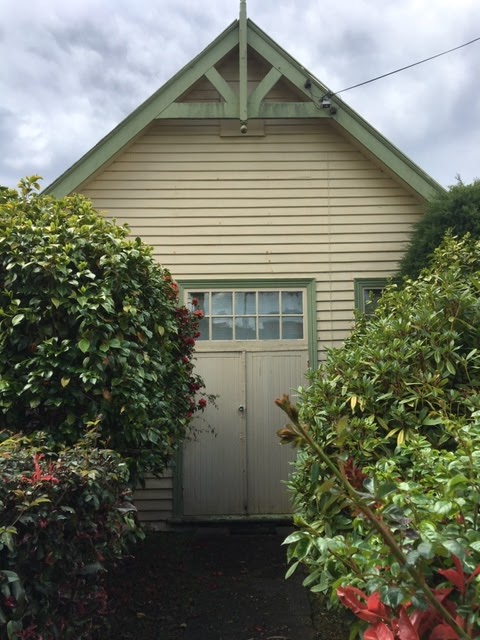
In 1915, Dover Salvation Army opened, built, painted, fenced and completed out buildings in record time, their own new hall, 20 feet by 40 on a stone foundation. Now a private residence.

In August 1924, when Mary was aged 74, she accidentally drowned. My maths says she would have been 71, anyway, it seems at 6:30 Saturday evening a small fire started in a wooden part of her chimney. Mary went outside with a dipper of water. As she hadn't returned in 10 minutes, Charles called for her. The night was dark, Mary was very shortsighted and there was no answer. Eventually neighbours and police found her body in the water at the foot of the twenty foot drop behind their house. Charles, son Frank and granddaughter Connie gave evidence at the inquest.


Mary's death in the War Cry

 So poor Mary had a sad end, but she had reached a good age and Charles stated at the inquest that he had been happily married for 54 years, my maths says 56 years, but we won't quibble.
Charles and Mary Rose's house on the waterfront at Dover
behind the house down to the bay........
           .....and again, the drop behind the house, now safely fenced off

Aunty Rene, one of  Kezia's daughters said grandmother Rose was a 'beautiful lady'. Charles died 17 months later at age 81. They would both be buried in the cemetery which is now the War Memorial where their son Charley is now commemorated.

The cemetery can be seen centre at the front in this pic on what is now the War Memorial.
Cover of Dover history Group's leaflet.


A History of Dover & Port Esperance, Norm Beechy & Dorothy Baker
Caroline Haigh- transcript UTas Convicts in Context Unit
Librariestas: Tasmanian Names Index
Lydia Nicholson-Convict Heritage Sites transcript UTas Convicts in Context Unit
Trove: Huon Times, 5 August 1924 article136038628
Trove: Tas Daily News 19 August 1857
War Cry, unknown source


Wednesday, September 19, 2018

Martin Cupit and the Headless Corpse


Martin Cupit

Before I embarked on the two UTas Convict study units, I knew I had one convict ancestor, namely Martin Cupit. My maternal grandmother was a Cupit before she married, and Martin was her grandfather, only a mere four generations back from me.

 Martin arrived in Van Diemen’s Land in 1852, the tail end of criminal transportation to VDL. The abolition of slavery by the Wigg political party  in England was to increasingly influence the abolition of transportation as awareness grew of a need to overhaul punishment and conditions for these convicts. Their crimes certainly didn’t begin to match their convictions. Martin and a group of his friends were caught poaching game and were all transported aboard the “Equestrian”. Martin was 5’ 11 ¾” tall, dark complexion, black hair. His height indicates he would have probably had a childhood free from malnourishment. Martin had his right arm tattooed with a mermaid and his left with a bird and heart. He left behind a wife and daughter in Derbyshire.

  
At least 37% of males and 17% of women were inked by their arrival to the colony with secret codes and images laden with meaning. The mermaid symbolised peril at sea, beauty and fear. The bird and heart no doubt symbolised love lost, flown away. 

Martin’s record isn’t particularly long winded. He was assigned to the Douglas River Coal Company, was fined for being drunk in Feb 1853, gained his Ticket of Leave in December 1853 and was again fined on Dec 26th, 1854 for being drunk and disturbing the peace.[i]

When he married Sarah Murphy in Franklin in 1862, his marriage certificate stated he was a laborer. How Martin ended up in Franklin, I don’t know. Franklin had plenty of convicts serving and working there, many of whom stayed on after their freedom was granted, bought or leased land and often did quite well for themselves. Martin must have made the choice to move there.  He probably labored for the many sawyers and timber workers in the Huon Valley. It was appealing work for many ex-convicts, hard, physical work they were familiar with, but with freedom from chains, gangs and masters. Records exist of women working hard with their partners carrying shingles, posts and palings on their shoulders to the beach.[ii] It was probably this kind of work that the Coroner’s verdict stated that killed poor Sarah in 1876. (previous blog)

The bare facts I have of Martin’s life after his marriage are that he and Sarah had two children William born in 1867, and Martina born in 1870 and they lived in a house owned by E.A. Walpole, Esq., P.M.

One snippet existing on Martin is a rather gruesome tale that was reported in Hobart’s Mercury newspaper. It involved Martin as a witness. In September 1866, a James Esson was accidentally drowned at Glaziers Bay. The body was placed in the police boat shed, and as was the norm, local doctor William Lee Dawson was summoned to examine the body as a medical witness. William Lee Dawson was a respected member of the Franklin community. He was a highly qualified Medical Practitioner who treated all the medical needs and emergencies including the dreadful injuries and deaths which ensued from the timber felling industry. He was appointed Deputy Registrar of Births, Deaths and Marriages for Franklin in 1856. He conducted inquests and his normal duties included examining victims of crime, both dead and alive. He was appointed Surgeon of the Huon Rifle Company, Southern Tas Volunteers and was nominated as a candidate to serve as a Member of the House of Assembly in 1861.[iii]


 On the 15th of October 1858, Dr Dawson and E.A. Walpole signed off on the deaths of Peter McEwan age 45, James Watson age 19, Annie Montgomery age 12, John McEwan age 5 and William Willgrave age 50, all killed by a fallen tree. 

Before E.A. Walpole, Esq., P.M., at the Police Office in Franklin the story was told. On the 9th of August, local farmer William Lovell and local undertaker Henry Newell both watched on in the boat shed as Dawson cut the head off the body and screwed the lid of the coffin down. The head was then taken away by a man known as “One-eye’d Jack”. As the plot thickens in what’s sounding quite like a Dickensian tale, John Whitemore was then employed to carry the man’s head (then in a bag) to Langford’s public house and show it to “Ratty” meaning Martin Cupit and also to Mr. Langford. John did as instructed and held the head up for the men to see. Two other witnesses were at the pub when Dawson came in, took the head and placed it in a waterhole near his home, then subsequently buried it. Martin and Mr. Langford collaborated the testimony adding that the head was decomposed and very offensive. The matter was then reported to the chief district constable
The next day Dr Dawson’s servant Henry Douglas, testified that Dawson opened the coffin and replaced the head back with the headless corpse. Dawson was fully committed for trial on this evidence. [iv]


image:  libraries tas


I don’t quite know what to make of this story. I’d love to know why this occurred and the backstory. How much of an insight does it give into Martin, or Ratty as he was known?
Was it a dare, a drunken promise or a threat? And if so, who was threatening or daring who? Why would Dawson risk his career and social standing? I reckon I’d be pretty safe in surmising that a fair bit of alcohol consumption could have been involved throughout the unfolding of the whole ordeal though. Without delving deeper into criminal records, I can’t say what happened to Dawson, except he does not appear in local newspapers again until five years later on the 28th June 1871 in the death notices at age 53. He died and was buried in Franklin.[v] 

His obituary in The Mercury on 30th June 1871 says of him that he was a benevolent, but rather eccentric practitioner (who) had been the favourite medical advisor to all persons in the Franklin district....His nature was of the true character of charity - universal, and consequently embracing all objects and persons, poor as well as rich. His skill as a surgeon and operator was not surpassed in this colony. He had his failings like other men, but they were unlike those of most colonists "written upon his sleeve" and exposed to public criticism. His virtues preponderated over what are called failings, and the attentions paid to his wearying sick bed show that he was beloved by those who laughed at his eccentricities, while they believed in his inestimable value as a citizen.

                                                                   google search William Lee Dawson: Sharon: Tree of Me genealogy blog

His Obituary doesn’t gloss over the fact that William Lee Dawson had very public eccentricities and failings, with this event probably being one of them. He sounds like a fascinating man and one that when I get a Time Machine, I’d love to pop back and have dinner with in his Franklin house. Maybe he was an 'on the spectrum' intelligent eccentric who din't quite know social boundaries, Franklin's Doc Martin? Researching Dawson and these colourful Franklin characters just makes me wish I could have been a fly on the wall.

 Martin’s life ends sadly and prematurely too. After losing Sarah on the 24th December 1876, I would hazard a guess that Martin’s probable alcohol dependence saw him through the next two years of his life until he died of dropsy and liver disease the day before Martina’s 8th birthday in November 1878, leaving the two children orphaned.

What became of William and Martina requires further research and a future blog post.


[i] Librariestas name Search convict record
[ii]North of Dover & Point Esperance : Police Point to Cairns Bay : how earliest settlers changed their lives / by Dorothy Baker. Page 4
[iii]     http://nla.gov.au/nla.news-article8797120; http://nla.gov.au/nla.news-article8798879;  ttp://nla.gov.au/nla.news-article202389235
[iv] http://nla.gov.au/nla.news-article8841810
[v] http://nla.gov.au/nla.news-article8866482

Friday, August 17, 2018

A Ghost Story

This story was read by firelight on a dark and stormy night at our house on Victoria Parade. We had a Show and Tell evening and this is what I shared:


This ghost story is a tale of tragical love and, like all good ghost stories, untimely death.  The setting was the town Devonport, Tasmania, the former then was named Formby. Ship building was conducted on the shores of the Mersey River in the late 1800’s. 

                                                      The launch of the Lizzie Taylor, East Devonport Inlet 1891.Shifting Sands, Faye Gardam

One day a shipbuilder’s son fell in love with a beautiful girl. Their eyes met at the Regatta in 1898. 
                                        Mersey Regatta. Shifting Sands, Faye Gardam


She was wearing a gown of Chantilly lace, she had a pretty face and a ponytail hanging down and a blood red rose with a blue ribbon pinned to her gown. They spent the afternoon together and vowed their undying love that night as a pale moon rose over the water and the celebratory fireworks exploded over their heads. She gave him the rose as they parted.
But alas, their love was ill-fated from the start. The young lass’ name was Jessie Drake and she came from the wrong side of the river. She was from Torquay (East Devonport) and the young man was from Formby (West Devonport) and back then a girl from the Downs of Pardoe would not be at all suitable match for a man of Victoria Parade . Jessie Drake was 16, only 16, oh but he loved her so and from then on the lad would row his little boat  over the river when he could, to spend precious moments together.

                                                                  Formby looking east to Torquay, Shifting Sands, Faye Gardam


When the lad’s father heard of these dalliances he was not happy. One evening after a meeting of the town’s founding fathers, he told of his serious concerns to Mr Oldaker. Mr McFie and Mr Fenton were listening on.
“Don’t worry old chap” interjected Mr Gunn, “leave it to me, I shall attend to the matter”
Mr Gunn was hoping for a marital pairing of his daughter with the shipbuilder’s son, but as she was a chunky, robust girl with several facial moles, this was never going to happen….as the shipbuilder’s son was gushingly gorgeous and psychological studies have proven overwhelmingly that similarly rated hotness always marries hotness of equal rating.
                                             Pintrest: Hot Vintage Men. The Handsome Victorian Gent

The next day Mr Gunn “announced”  the engagement of his daughter to the shipbuilder’s son within earshot of Mr Drake, Jessie’s father. Thinking nothing of it, Mr Drake retold the local news at his family dinner table that evening. Jessie went pale. Tears welled up and she felt ill, so excused herself quickly from the table.
Jessie went to bed and cried all night.
Before dawn she, beside herself with grief, ran down to the river bank. She called her sweetheart’s name, knowing he slept in the attic bedroom at the front of the house with the window open. The water was wide and she couldn’t cross o’er, if only he would come with his boat. But the lad slept soundly, hearing her voice weave its way into his dreams but not awakening. The tide was low and the pale moon illuminated a pathway across the river, but alas, as the sea mists rolled in, that pathway lured Jessie into its depths.

The next day news of Jessie’s death spread through the town. When the young man heard, grief stricken he went to the water’s edge, there at his feet he found a blood red rose and a blue ribbon.


The lad never recovered from losing Jessie, and certainly never married Mr. Gunn’s daughter. He put all his efforts into building a beautiful timber boat, which he named the Jessie Drake. He sailed it to Melbourne, where he bought one hundred blood-red rose bushes. That night he sailed home, and the weather was terrible. He was warned not to sail. He fought all night with the wild Bass Strait tempests, but finally when the wind was a torrent of darkness and the pale moon was a ghostly galleon, within knots of Port Frederick all was lost and the Jessie Drake went down.
The next morning dozens of blood red roses bushes were scattered on the shore.

And over the years, in the early hours of the morning when the sea mist rolls in and a pale moon shines a pathway over the waters, many have told of a ghostly ship sailing into Port Frederick with the ghost of a young man aboard calling his lost lover’s name, and, many an East Devonport residence has attested to hearing, as the fog thickens, the voice of a girl calling a name the same as was the young ship builder’s sons.


So as you walk through the streets of old Formby Town, if you see any blood red roses growing on old gnarled bushes, chances are they are from the young man’s cargo, as the locals salvaged them, and, as they were bare rooted and it was late August, they survived, because as any keen gardener knows its dashed near impossible to kill a rose, and they planted them in their gardens, and some still flower today.

Disclaimer:

                                                           Pintrest: Group portrait of Victorian gentlemen

 This story and characters are fictitious. Certain long-standing institutions, agencies, and public offices are mentioned, but the characters involved are wholly imaginary.

Monday, July 23, 2018


Mary Breen, Brien, Gray

The Blackfriar arrived in Hobart on the 27th of May 1851. This ship would be one of the last to bring a full ship load of female convicts from Ireland, as transportation would be ended in a few short years from 1851. One of these women on this ship was Mary Breen. By the 1850’s record keeping for the convict population was much improved, but still it began with the “mug shot” and the noting of crimes committed, family records and marital status by the Muster Master.[i] 


                                                                                                               Linc Tasmanian Names Index

Mary with her dark complexion, dark brown hair and dark blue eyes, reported she was the defacto of George Murphy, sister of Ann, who, she had reported, had gone to America that year. Mary listed a sister, Biddy also. Her ten-year-old daughter, Sarah Murphy, was named and accompanying her. Mary was thirty, a country servant and had stolen a petticoat, some wheat and was transported on her third offence of stealing a cloak. Some Irish women stole continuously until they were transported with the lure of a fresh start on the other side of the world and free passage being a strong drawcard. Whether this was the case for Mary or not is a guess only. And what of her ten-year-old daughter? Did she speculate on her life too, trusting she would have to have a better future ahead of her in the new colony, possibly without a mother than was their life in Ireland? At least they had escaped with their lives from what was Europe's worst ever famine.
Sarah was admitted to the Queen’s Orphanage at New Town by the 3rd of June less than a week after arrival. [ii]
At ten, she was old enough to understand what was becoming of her life, but its incredibly difficult to imagine her interpretation of her life at this stage and how both mother and daughter coped with this wrench of separation. Mary was written up as quiet on her goal report but troublesome on the Surgeon’s report on board ship.
 On the 7th of June, Mary was at New Town Farm. This was the farm where the Orphan School stood and there was plenty of convict labour building and farming on the precinct. I can’t help but wonder if Mary and Sarah had any contact. Each Sunday church attendance was required for convicts and children. The children sat on the balcony in the cavernous roof space of the church looking down on the congregation below. The convicts sat in the opposite balcony. The congregation below had no need to look up and remind themselves they were partaking of the same spiritual food as their inferior-classed parishioners. Did Mary and Sarah steal glances at each other or smile and share knowing eye contact?


Inside St Johns New Town


By the end of June, Mary was sent to serve at the property of W Murray in Elizabeth Street. Nine days later she was out to Brickfields, clearly her first posting was quickly deemed as unsatisfactory. Brickfields was a depot to enable the hiring of convict servants. The North Hobart football oval now covers the site where it once stood. In October it was off to the House of Correction. This was the Female Factory at Cascades where strategies could be implemented to correct a woman’s behaviour.  In early January the next year she was back to Brickfields, and one month later in service again to a M Stanley in Veterans Row, Hobart. This service lasted four months. In June she was back to Brickfields for one day only and then on to service again with W Boucher in Melville Street. Twenty days later, it was back at Brickfields, and a week later with a John Elliot of Elizabeth Street. Three weeks later, Brickfields again, with another three weeks seeing her back at the Female Factory.
A trend in Mary’s conduct is beginning to form for the researcher.
After four months of “correction:, Mary is on 28th December back in Elizabeth Street in service of John Davis. This lasts two and a half months until she is at the factory once again.
On the 8th of April 1853, Mary is assigned at Pitt Water to G Marshall. After five months she is once again at the factory. The pattern is continuously repeated this way for the next four years.

I can’t help but ponder Mary’s situation. She was now approaching forty, she was a mature woman. What provoked this pattern in her life? Was she a fiery, spirited Irishwoman, or was she a difficult one who resented her circumstances? Were women like her treated appallingly by their middle-class employers and discarded because of trivial offences?

                                                                     What was once a solitary confinement cell at Cascades. www.kidbucketlist.com.au    


Punishment Books can shed a little light on Mary’s behavior. During Mary’s first stint at Cascades it was recorded she was ‘not performing her work in a proper manner’ by Mr Horan her overseer. She was put into solitary confinement for three days. A couple of weeks later she was ‘disorderly at night’ and was separated for ten days and put on bread and water treatment for three days by Miss McCullagh the Matron.
All’s quiet for a year until in 1853 she was charged with refusing to work and insolence for a Mr Cooney. Six months hard labour and 9 days in the factory was the punishment. Insolence again was the charge later that year by John Davies, with seven days in the cells as punishment. A week later 6 months hard labour again for making a false statement. Once again this is a pattern in her behavior, insolence, language and neglect of duty. The overseers must have been quite unsurprised to see repeat customers like Mary back in their prisons and centers. In 1853 it was recorded that Mary was not to enter service in Hobart Town. This was common for more troublesome convicts as it was hoped getting them on to a more remote location would slow down their troublesome postings and keep them out of trouble in places like the streets, the pubs and keep women ‘off the town’. This sort of behavior was common among the convict women, but for our Mary this doesn’t seem to be the problem. You can readily read in the newspapers of the time about the exploits on the streets of Hobart of plenty of women charged with prostitution, drunkenness, stealing and unsavory behavior on the streets. This doesn’t seem to be Mary. She was never listed as drunk, pregnant, in bed with a man or with stealing. She just seems to have had a bit of an attitude problem.

Mary is indeed mentioned in the local papers on a couple of occasions. On the 16th of June 1855, Mary was assigned to work for D.C. John Smith. John Smith was a policeman.

D.C. John Smith was with  the Water Police and spend his time apprehending absconders, so he would have been used to dealing with criminals. He charged a ticket of leave girl, Jane Hurley, with absconding. She was at large for over two months until she was found aboard the Trition in Sydney. In her defense she said had had gone on board to drink tea when the vessel sailed.[iii]
Prussian passholder Constantine Asquith was charged by Smith when he was found concealed on board the steamer Tasmania with intent to leave the colony. Asquith was an intelligent man and in his foreign accent pleaded his case eloquently. Basically he was fed up with his colonial life and wanted to get home to his old life, who could blame him?[iv]
Smith dealt with all the sort of crimes which you’d expect to arise in the town of Hobart on and around the docks, riots, firearms, ballast dumped in the harbor, illegal supply of rum, so presumably when Mary Breen came as a domestic servant to his home in June of 1855, he would have been pretty savvy with the criminal class and had heard every story before.

Battery Point is the background for this 1878 photo of Hobart's docks: the 'new wharf', warehouses, signal station, and, top right, dwellings (W.L. Crowther library, SLT)


On the evening of the 6th of July, Mary had been ‘very insolent to her mistress’ it was reported in Monday’s Hobarton Mercury. John threatened Mary with punishment if she persisted with  her conduct; she then 'took to the sulks and would not get up the following day till Mr Smith made her do so'. Its amusing to visualize, John Smith banging on her door, perhaps even pulling a recalcitrant Mary from her bed. Not so amusing for Mary, charged with misconduct in lying in bed until 12 o’clock and sent back for three months hard labour at the factory.

Four postings and not quite a year later and Mary hits the newspapers again. Mary was serving the Reynolds. Mr Reynolds, a Bench Clerk, brought Mary before Mr Fenwick because she had  been insolent and threatening Mr Reynolds’ sister. Mary then ‘poured forth a stream of low vituperation on Mr Reynolds and his family, which was not cut short even when the sitting magistrate ordered her to be sentenced to a probation of six months. Mr Fenwick then became the object of the amiable lady’s attack, the prisoner valiantly threatening that gentleman that she would take care and have the case seen into. Her insolence was so vehement that Mr Fenwick sentenced her to six months imprisonment with hard labour for her contempt of the bench, the woman still uttering threats and impertinence.’[v]

Mary was to have one final posting after nearly a year at the House of Correction. In April 1857 she was with Mrs Thomas in Macquarie Street. In July 1857 she gained her Certificate of Freedom.
In these six years Mary was sent to the House of Correction no less then twenty times, with punishments such as several months hard labour, seven days in the cells, three days solitary confinement, three days bread and water treatment and 48 hours bread and water in punishment dress.


St John’s, Franklin, St Mary’s was demolished and St John’s built adjacent in 1863. ontheconvicttrail blogspot


Two years later in 1859, a Mary Brien marries a George Gray at St Mary’s Church, Franklin. He is a farmer, she a widow, he is 50 and she is 44.[vi] 
Her age is not right, her marital status is not right, and her name is not right, but we never let little things like this get in the way of a researcher on a roll. The one thing that does raise the antennas is that she married in Franklin, a growing town on the Huon River south of Hobart. On Mary’s Female Convict Research Center notes, it states she was also known as Mary Brien. Surely with an Irish accent the name Brien and Breen would sound the same?
So, does Mary finally find a little happiness and peace with freedom and married life? The descendant can’t help but look back through their modern-day lenses and hope for such an outcome. But life isn’t that simple.
Three years later her daughter Sarah marries Martin Cupit in Franklin. Did mother and daughter finally have a few years together again after their forced separation? Is this how Sarah ended up in Franklin, mother and daughter were together here? Was Mary at their wedding as a beaming mother of the bride, happy to see her daughter grown up and making a good life for herself? Did Mary get to enjoy her two grandchildren born in 1867 and 1870?

The clincher in the deal that this indeed is our Mary, comes in the form of a Hobart Town Public Cemetery document. On the 1st of May 1875 Mary Brien ex Gray (does this mean she is no longer with George?), born in Wexford, Ireland, age 54 is buried in a pauper grave. The age, the birth place and the religion (Roman Catholic) adds up. She dies of diarrhea and debility in a residence on the corner of Molle and Golbourn Streets in Hobart.[vii] It would seem Mary never got her happy ending. Perhaps she was a difficult woman, perhaps she suffered from mental illness or perhaps she was crushed by a system which intended to do just that, force conformity, suppress personal freedom and ‘reform’ the wild ones. If Sarah and Mary were reunited, sadly it wasn’t for long.

As I look back on these women’s lives I can’t help but wonder. Were these convict women all wild, sinful, damned whores as the male government authorities painted them? Were they all criminals, 1800’s versions of a bogan or government handout dependent class? I’m sure nothing is that easily definable and that individuals were as complex and varied then as they are today

And what of Mary?  She had left Ireland during the worst famine in European history. Charles Smith, the ship’s surgeon on another female convict ship wrote in 1850 of the Irish women on board:

‘About two thirds of the convicts were between the ages of twenty and thirty…. Many of them had been driven to commit offences during the famine of Ireland, who originally had a very good character…. being a highly susceptible race they suffered much at first from grief and dispossession of spirits on leaving their friends and mother country.’

‘but many of the females suffered occasionally from hysterical fits who were not put on the sick lists as the paroxysms were of short duration.’ In other words, many of these women suffered nervous breakdowns, to use an outdated term.[viii]

 As I read and researched about Mary, I couldn’t help but relate to her, and think that she really did remind me of myself, and how I think I might have reacted if I were put in her shoes.

                                                                       1850 ladies shoes     Pintrest: whittakerauction.smugmug.com


[i] Archives Office of Tasmania – digitised record
Item: CON41-1-30 
[iii] 1852 'POLICE REPORT.', Hobarton Guardian, or, True Friend of Tasmania (Hobart, Tas. : 1847 - 1854), 25 December, p. 3. , viewed 03 Jul 2018, http://nla.gov.au/nla.news-article173063230
[iv] 1854 'Police.', The Tasmanian Colonist (Hobart Town, Tas. : 1851 - 1855), 24 April, p. 2. , viewed 03 Jul 2018, http://nla.gov.au/nla.news-article226469261
[v] 1856 Courier trove.nla.gov.au/nla.news-article2503925
[vi] Linc names search
[vii] Family search Mary brien
[viii] Surgeons Journal, AJCP Adm. 101/20 Duke of Cornwall