Friday, December 8, 2023

 The Hardy Boys: the family that robs, assults and comitts arson together, stays together.


Linda May Rose

Linda was the seventh child of Charles and Mary Rose and was born in 1884. She was born while the family lived at Fleurty’s Point, near Castle Forbes Bay, before the family moved to Dover. 

The first notable thing about her is her name. By the 1940’s, Linda was the second most popular girls name, but in 1884, it was far more unusual. The Roses picked most unusual names for their children, like Nalta Rummond, Luther Charles Garnet and my ggrandmother, Kezia Athaliah. But, I'll get to those later. Linda is the first ancestry biography of all the Rose children.

Searches for our Linda bring a few results. There is her birth (where her name is spelled Linder), her marriage to William Hardy on the 9th March, 1901; and the subsequent ten children’s births-

William Victor (1902), Frank Edgar, Bernie Gallingham, Walter Rueman, Herbert George aka James, Connie Maisie May, Coral Ena Vay, Charles Robert, Linda Mavis and Mytle Irene (1919).


                                                     Ancestry.com, source unknown

 There is however a little more information on Linda’s husband, William Hardy.

William had already spent twelve months in prison seven years before they married.

  
 William Hardy Sen, 15/5/1894, twelve months for housebreaking. Libraries Tas                                                                                                                                                                              

The most insight we get into Linda’s life comes through her husband and children, with greatest coming from a fifty-six-page documentation of two of her sons' crime records.


The 1921 crime spree

The Onset   


By June, Frank and William had used their first and only First Offenders Act get out of jail free card.

 June 1921. The Files

Bertie 16 years.

On the 18th June, 1921, Dover Police Court filled out a Conviction of a Youth Offender form for young Bertie Gallington Hardy. Bertie did feloniously break and enter the Butchers Shop of Charles Palmer at Dover, and stole 2 £l notes, 1 pound of silver and one revolver. He was then committed to the care of the Boy’s Training School. This institution in New Town was to move north the following year, 1922, and become Ashley Home for Boys. 

The particulars of his parents list his father, William Hardy in Hobart Gaol, and his mother Linda May Hardy (Rose) of Dover; Occupation: Domestic.


Back then, boys institutionalised for crime were hired out for cheap labour. By March 30, 1922, F.B Jones had filled in an Application for a Boy for Service form, and Bertie was the boy dispatched to Mr Jones of Margate on the 11th April, 1922. His wages were to be 5 shillings a week, with 3s 6d a week payable quarterly to the Department, and the balance given weekly to the boy as pocket money. Even in today’s money (about $22), that’s very cheap labour.

Eight months later, Bertie went on one of his regular Sunday morning walks and failed to return. Mr Jones reported the absconding to the police. Correspondence over the next few weeks reveals Bertie had not been found and Mr Jones suggested he may have “returned to his people at Dover” and the “Pleasman is keeping a look out”.

              Libraries Tas

Three days before Christmas, the lad was arrested at Dover and sent temporarily to the New Town Infirmary & Consumptive Home.

By 1928, Bertie’s records reveal he was handed  £7 that was held in trust for him during his time as a Ward of the State.


Walter, 14 years.

Page 30 of this documentation brings Walter into the crime spree. Walter Reuman Hardy is convicted of the felonious break and enter of the shop of Price Brothers, where he stole two sovereigns, £1, 18s, and one gunmetal watch on the 14th June 1921, four days earlier than his brother’s crime.

Walter, like his brother, absconded from incarceration, back to Dover by September 1921, and by October, he was sent by the ferry Excella to Mr Nigel Pearce of Flowerpot under the same arrangement as his brother.

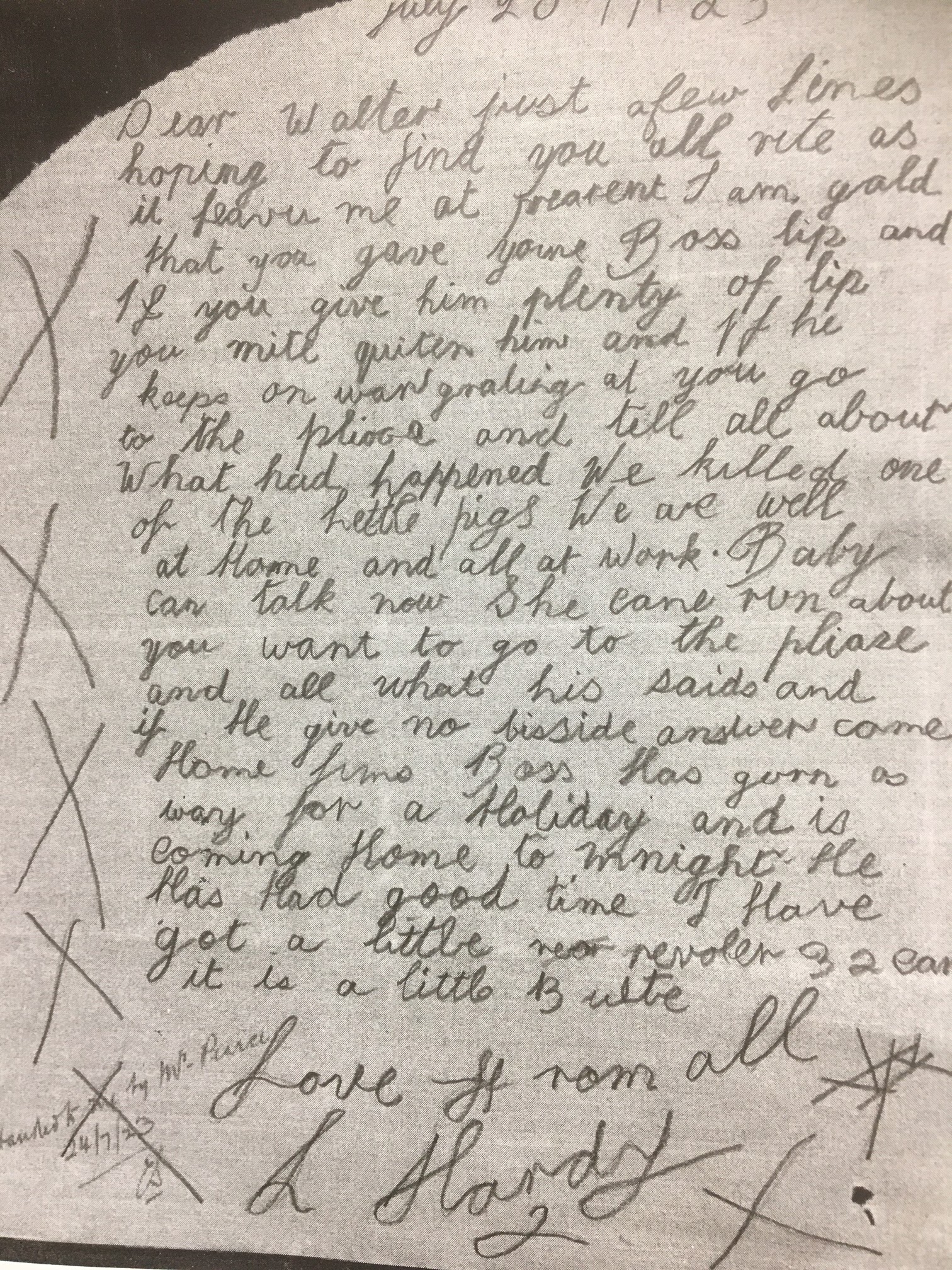
Presumably Walter’s mother wrote to her sons regularly. One of her letters is among the correspondence, one that the authorities weren’t too happy with. In July 1923, the Secretary of the Department of Children of the State, wrote to Mrs Wm. Hardy admonishing her in her encouragement in her son’s misbehaving and threatening a return to institutionalisation.

                                                             Libraries Tas

 In her letter she encourages Bertie to ‘give the Boss plenty of lip to quieten him’, and to ‘go to the police and tell them what happened’. 
                               Libraries Tas

Surrounded by affectionately large kisses and signed, not Mum or Mother, but L Hardy, her love and concern for her son is obvious. She seems happy with her new revolver and is keen to report that to Walter.

It’s interesting to speculate the circumstances. Minors hired out at cheap labour were readily abused. Was Bertie one such boy with a mother doing her best to protect him? Or was Bertie a young man with a bad attitude? Whatever the circumstances, Bertie stayed at Flowerpot with Mr Pearce for the next two years. Pearce writes that the lad is well liked in the district and has the makings of an industrious and upright citizen. Final correspondence reveals Bertie and his brother have obtained a selection of 100 acres at Port Esperance. He requests release of his money to buy a “moter byke”, and then more for survey fees, and finally the sum of £29 is released to him for clearing his land.

  Libraries Tas


 The Two Eldest Boys

William Victor Albury, age 20.

According to newspaper reports, the crime spree of June 1921 involved father, eldest son William, third son Bertie and fourth son Walter. William jnr was of age when his crime caught up with him. He was placed in the Hobart Gaol on 13th June for 3 months for Receiving. Early August he was found having tobacco in his possession not issued by Gaol authorities. By October having served his first stint, he was convicted with Larceny and sentenced to another 3 months.


                                       Libraries Tas

 William senior was sentenced to twelve months imprisonment on 13 June, 1921. He was awarded Freedom by Special Permission on 11 March, 1922.


Frank Edgar Olga, age 19.

With no record coming up as a criminal, perhaps Frank, the 2nd son was not involved in the 1921 family crime spree. A search for Frank in the Huon Times newspaper however reveals thirteen reports of crime between 1922 and 1932. It can only be surmised that for each crime, there were others executed and evaded by local police. Most of Frank’s crimes were minor, except for a rather nasty grievous bodily harm inflicted with an axe. Perhaps Frank was imprisoned for this one, as things go quiet for him from this date to the inquest of his death in 1941, aged 38. 

               Libraries Tas

Frank was connecting high tension electric wires carrying 11,00 volts and was electrocuted by his own act of misadventure.

Trove. Examiner, 25th September 1931

Herbert George & Charles Robert

The youngest two boys were twelve and nine during the 1921 family crime spree, but crime was not to evade them either. Ten years later we find another spree involving Herbert, which starts in January with the larceny of motor tools. Then in April 1931, eighteen-year-old Charles and twenty-two-year-old Herbert find themselves at the Dover Police Court before two JP’s and Inspector Grant, charged with having damaged six apple trees. The boys pleaded not guilty, but evidence was given that they had wilfully rolled stones down a hill so that they would strike the trees in the plaintiff’s orchard.

 By May, things escalate from a childish act of vandalism, to one of arson for Herbert. He is found before the Coroner on May 21st 1931, along with his brothers Frank and Walter, in the investigation of the burning of a barn. Here we read, Herbert, age 22, is aka James. Evidence was found to charge Herbert with the felonious setting on fire of the barn, with insufficient evidence to implicate Frank and Walter. Herbert was committed for trial at the next sitting of the Supreme Court. This same report brings up another suspicious barn fire six months previously.

Charles Hardy Ancestry.com source unknown

For the most part, the boys married, had some children, and lived reasonably long lives.

 Linda and William also had four daughters, Connie Maisie May, Coral Ena Vay, Linda Mavis and Myrtle Irene. 

 The Girls

Connie, the eldest daughter, was almost thirteen when she is mentioned as a witness at the death and inquest of her grandmother Mary Rose in August 1924. Connie was at her grandparents’ home at the time, perhaps living with them. Family records state Connie then went to live with Mary’s eldest daughter, Linda's sister, Kezia, who was then in Franklin with most of her children by then young adults. Remembrances state Connie was ‘quite a handful’. Six years later she married Hadley Pirie Pepper in Hobart, and they had five children. Connie Pepper died in Hobart in 1996.

Coral and Linda, so far evade me in most searches. Linda must have gone by her middle name as she (Mavis) placed a memorial for her mother in the Mercury in May 1938. Mavis was then twenty-one. 

 Myrtle

In Linda (sen)’s 1923 letter to her son, she mentions that ‘Baby can talk now’, and that ‘she can run about’. Even with her tenth child, Linda was marking childhood milestones and reporting them proudly to 'baby's' older brother.

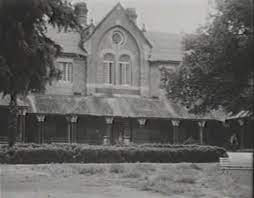
 This would have been Myrtle, who was two when Walter became a Ward of the State. Things seem to have gone sadly for Myrtle. Perhaps she had a congenital issue, perhaps she contracted a childhood illness, or mental illness, but at age nineteen, she was in the New Town Charitable Institute for nine weeks.

 She was listed as a domestic and as a mental d; presumably the 'd' stands for deficient. An inquest into her death in March 1948 found it to be natural causes and bronchopneumonia. Myrtle died at age twenty-eight at Lachlan Park Hospital, New Norfolk, a secure Mental Asylum, where she presumably had been living, perhaps for the previous eleven years.
 

Lachlan Park Hospital. Willow Court History group.


 Linda May Rose/ Hardy died in 1931.

The Huon Times gives a small obituary of Linda's death at age 48 in 1931, after a long and painful illness. Myrtle, the youingest of William and Linda's children, was only eleven years of age. 


Linda’s husband William had his third and final stint in Hobart Gaol in 1934. He served three months for receiving. His mug shot reveals a fifty-nine-year-old man looking much older than his years, a man who has lived a hard life and has endured plenty of life’s tough struggles. When William died at age sixty-four, in1939, his will reveals he had married again and his widow, Florence Bertha Hardy, was both executrix and sole beneficiary of his real and personal estate.

                                                        Libraries Tas

Saturday, April 9, 2022

Hardy Old Huonite


Ancestor Biography:


                                                        Hookey Jack Lovell


You can’t see the tree for the leaves.’ Useful for the home family tree researcher, or recreational genealogist as it is now called. You find yourself out on some distant limb, swaying precariously, picking up every leaf and seeing if it is sprouting from the correct tree or not. This is how I came across John Isaac Lovell.


I was looking for information on his sister, an unnamed baby girl born somewhere in the Huon River district to Samuel Lovell and Elizabeth Smith on Christmas Day, 1852. A side note scrawled in a different hand noted she was baptised in the Wesley Church as Elizabeth Margaret. Confusingly, this girl was always known as Mary. John Isaac was the eldest and only son of the family of five, and Mary, the youngest. The other three sisters remain equally as elusive as Mary. Their mother Elizabeth died in 1854, when little Mary was fifteen months old.

John Isaac popped up in plenty of family tree matches on genealogy websites with varying siblings and parents, but always called “Hookey Jack” Lovell. What a great name!

 A census reveals John Isaac and his parents in Franklin between 1848 and 1851. They lived in Geeveston and then Castle Forbes Bay. John grew up when the Huon Valley was an isolated but rapidly emerging area. The pioneers were bushmen who felled the forest giants, milled the timber and shipped it to Hobart and the mainland to the growing colony’s cities.


 At age eighteen, John was employed by a Mr Kellaway at Woodstock. He had not been working there long, when he was out one day shooting parrots. He signalled to his companion to keep quiet, knocked the trigger of his gun causing it to explode and the ensuing charge shattered his forearm.  Mr Kellaway conveyed young John to the doctor at Franklin. Without the use of chloroform or any type of anaesthetic, reportedly, young Lovell watched the amputation of his forearm without flinching. As soon as the limb was healed, he was fitted with an iron hook, thus explaining and validating the truth of his wonderful nick name.

After leaving Kellaway’s he went to work for Lucas’ Mill at Baker’s Creek. It was here he met and married the daughter of John Bell. On October 10, 1864 when Sarah Bell was seventeen, and he was twenty, they were married by Richard Cook in the house of E. Dowling, Franklin. On Christmas Day that same year, their first child was born.


The young couple bought land in Baker’s Creek and gradually laid out a farm of apples, pears and small fruits, in what would become the predominant agricultural industry of the Huon Valley for the next one hundred years. 

Ranelagh. Tas Archives


While the orchard was establishing, Hookey Jack worked as a timber getter. Despite his physical handicap, he worked at phenomenal speed. He was the champion pailing- splitter of the district, frequently tallying 800 a day, with a record of about 5000 in one day.


Huon timber men. Tas Archives


His orchard grew as did his family. Hookey Jack and Sarah went on to have seven more sons and seven daughters.


Sarah died in 1915, in her late 60’s, several months after a stroke.


 Hookey Jack and his sons and daughters placed a heartfelt memorial to her in the Huon Times when she passed and again a year after her death.


Two shocking events occurred for the family in the ensuing few years. On Wednesday 11th of June, 1919, John Isaac jnr, then aged forty, was taking 28 cases of apples from Baker’s Creek to the Huonville sales. The cartwheel hit a sandy rut and he was thrown to the road, became entangled in the reins and was dragged along the road and eventually run over by the cart, causing dreadful injuries. “Don’t touch me, I’m cooked,” was what John told his employee who was with him at the time when he came to his aid. Hookey Jack had the sad duty of identifying his son’s body in Hobart on Saturday when the man finally succumbed to his dreadful injuries three days later.

Timber Carter on the Huon Road


In 1923 another son, James met his sad and awful death too.

 On Tuesday the 19th of June, James was at the box-mill of Mr Chas Woods at Ranelagh. James began to push some billets through when one jammed. A piece five inches thick was hurled through the air at tremendous force and hit James in the head. An unconscious James was motored by Mr S Shepperd to the Hobart hospital, arriving at 2:30 pm, a trip which took them three hours. His injuries consisted of fractures to the skull, nose, cheek and upper jaw. Part of the brain was exposed and missing. During the evening he regained consciousness but relapsed towards morning. At 11:00 he took a bad turn, and everything was done to relieve the unfortunate man. He appeared to suffer distressing agony and died at one o’clock on Wednesday afternoon. The newspaper reports that ‘the deceased was thirty-four years of age and left a widow and two young children to mourn their loss. He was a well respected as a hard-working orchard labourer and much sympathy is felt throughout the Ranelagh district for the bereaved family.’


Huon Valley sawmill. Tas Mail 1903


Hookey Jack himself ‘joined the great majority’ early on Sunday morning, the 1st of June 1924 aged eighty years and four months. 


 Sadly, the risks these pioneers faced in the timber and orchard industry, played out badly for Hookey Jack, with two of his son’s deaths.


His obituary states that fortune did not always smile on his efforts, but that he carried his troubles lightly, always finding something to be thankful for and always ready with a cheery word or helping hand for others. His hardy constitution was taxed several times through serious accidents.

Hookey Jack as an older man.


It was in the research of Hookey Jack that I found two little hints about his sisters. The first was Mary.

From the Huon Times 19th of August 1924: A southern correspondent writes:

“The passing of Mrs Rose, of Dover, is another break in the list of old Huon pioneers. Deceased was well known in her young days at Castle Forbes Bay, Franklin and Cradoc. At the last-named place, deceased and her husband were employed for a time by the late Mr J. Rowe. Her brother, Mr John Lovell, of the Grove passed away only a few weeks ago reference to which sad event was made in the ‘Huon Times.’” It is always pleasing to get confirmation such as this that you have the correct Lovell on the correct tree.

The second hint was mention of another sister at the end of his obituary: “Deceased had a long line of descendants- 96 grandchildren and 68 great grandchildren. A younger sister, Mrs Rowe, is living at Hastings.” Ah-ha. This must be the elusive Hannah, or perhaps the thrice married Susanna, and has given me a new branch to climb out upon.


Sources

Libraries Tasmania NAME_INDEXES:957161

Libraries Tasmania NAME_INDEXES:1192210

Libraries Tasmania NAME_INDEXES:479319

Libraries Tasmania NAME_INDEXES:479321

Trove: nla.gov.au/nla.news-article15690252

Trove: nla.gov.au/nla.news-article136200553

Trove: nla.gov.au/nla.news-article135820121

Trove: nla.gov.au/nla.news-article12361766

Trove: nla.gov.au/nla.news-article136182511

Trove: nla.gov.au/nla.news-article136036077

Libraries Tasmania Archive images


Monday, May 13, 2019

Martina Cupit, the lost Aunt.

The story of Martina Cupit is a sad one. Hers is the story of what happens when hundreds of people have been sentenced to Transportation to Parts Beyond the Seas, hundreds of people who would now only have their sentence and their new home in common. Like all children of convicts, Martina had no grandparents, no cousins, no extended family, no one to step in and care for her when tragedy struck, which it did in 1878 when Martina who had just turned 8, and  her and her brother William, 11, became orphaned.

When their mother Sarah Murphy had died, and then their father Martin Cupit also passed, the children Martina and William were separated. Family stories tell that Martina was taken by the Franklin Catholic Church, and William by the local C of E. William remained in Franklin, their home town and never saw his sister again..

St Josephs Orphanage Registry  SWD 37 Libraries Tas

Four years after the children were separated, Martina was admitted into St Josephs Orphanage in Hobart. Where she had been those four years was unknown to her brother then and remains so to her family still trying to piece together her life today. Her Orphanage record entries show each year she was granted an extension until 1890. Unusually she stayed on at the Orphanage until she was 20. Perhaps she worked there or undertook some sort of Order in the church.

St Josephs Orphanage, Harrington Street, Hobart. State Library of Victoria

Martina's life must have taken a big turn on leaving the environment she had lived in for 8 years. She probably gained some employment, as by 1894 she was living in Launceston. Her daughter Eleanor May's birth was registered on 3 November 1894, with no father's name. Martina's address was recorded as 27 York Street.

Daily Telegraph 1 Sept 1894 Trove 

27 York Street, it would seem was some sort of hospital which also offered adoption services.
It is possible that the baby girl offered for adoption in Tuesday's paper 4th February may even have been Eleanor, but sadly at age 3 months on the 5th of February little Eleanor died.

Daily Telegraph 4 Feb 1895 Trove

In November 1896 Martina marries Toy Yot, a Chinese hawker, at the manse of the York Street Baptist Chapel. The local Baptist church is one that is very inclusive of the significant Chinese community in Launceston at that time. Obviously Martina has left her Catholic upbringing behind her somewhat.

Libraries tas

Martina lists her occupation as a domestic servant, her father as Martin Cupid, and her mother as the unknown Christina Norton. Perhaps this lady was the woman who took her for the missing four years? I've certainly found no record of this elusive lady.

The Chinese Community.

Although small (around 1000 in 1891), the Chinese community's local contribution is significant. The Chinese men who came to Tasmania around that time worked in the tin mines of the north east area. Most made their money and then returned to China. Some like, Toy Yot, stayed on and ran businesses, market gardens and even married local women. These men were generally respected in the community as hard working, honest men who contributed to the community, actively raising money for schools and hospitals. It was a Chinese Carnival that raised the funds to construct the Gorge pathway to the First Basin. 

However life wasn't always rosy for these men. A letter to the Editor of the Examiner in 1880 expressed some of the most dreadful and extreme views, calling these chinamen 'not of the highest order' and any European women they take on as a partner to be 'degraded beings' and 'scum of the earth'. The terrible tirade goes on to predict the children of such unions as a 'little generation of vipers who will form the very essence of vice and crime, besides tarnishing European blood and importing unknown diseases into the colony'. Whether Martina  faced this prejudice isn't known, but in 1897 they had their first child, Selma May. Their home is documented as 2/4 West Street. West Street and North Street form a tiny little laned network of old cottages flanked with bluestone gutters in the area of South Launceston nearby to where Toy would have run his market garden from.
Of the Chinese who stayed in Launceston, some did well. Men such as James Chung-Gon who also ran a market garden and a store. Toy would probably have had business and personal dealings with his fellow country-men who had made their home here.

James and Mary Chung-Gon sit for a family portrait with their children ( - Courtesy the Chung-Gon family) source  www.abc.net.au/localstories


Certainly newspaper reports would indicate Toy had to stand up for himself. One of several reports  saw Toy assulted at the Chinese New Year celebrations in 1902. These celebrations were a time for the Launceston countrymen to mingle together, talk, eat, smoke and take tea, to reminisce and the hard working men would stop work for a few days. The evenings would hold festivities including lanterns, fireworks and more food. It was at 8:30 on Sunday evening during these celebrations when Toy Yot was assulted by a group of youths who started throwing stones at him. Onlookers called the police and the offenders ran off. At the trial conflicting evidence was  was heard in the Police Court. The 15 year old pleaded not guilty and his defence lawyer stated that it was quite possible Toy was struck by a firework which could cause the pain he complained of. The plaintiff, who displayed much intelligence, and a thorough grasp of cross examining the witnesses, conducted his own case. The defendant admitted one of his mates called out "Muckahi" (as extremely derogatory term) to Toy. The Police Magistrate after lecturing the defendant and the young guy who verbally abused Toy, dismissed the case.

Whatever life was like for Toy and Martina, there time together was short. As the years had progressed, her brother William was still in Franklin, in the south of the state. He was married in 1896 and begun his own family. He had a store in the town and continued to ask the catholic priest at the time about his sister. His hostility grew as he obtained no answers.

The search that William had started, I could not resolve either. Martina and Selma appear on no searches, with site after site revealing nothing, including no death record. My suspicions are mounting, if she had descendants, she'd be on an internet family tree site. Toy, however still leaves me some clues.
In 1901 Toy pops a little notice in the local paper:

"My wife having left home without cause, anyone harboring her after this date will be prosectuted
Toy Yot, Market Gardner"

Hmmm, this poses a few questions. Jump back a year, 1900 was the year that produced two documents about Martina's fate. In July 1900, another marriage certificate emerges. Toy married Eva Christmas. I pay my money to apply for their original certificate in hope of ascertaining whether Toy is divorced or a widower. The document states he is a widower. There, sadly is my answer. So now I have a rough date and I apply to the registry for her death certificate. The next day I received a phone call from them stating they hold no record of her death. Her death was obviously not registered. The nice girl on the phone says she'll photocopy the new marriage certificate for me so I at least get my monies worth in some form or another. The original document reveals more than the transcribed one. Martina had died in 1899 and had left two living children. Toy was left with two small children and hastily married the 19 year old Eva who ran out on him in 1901. I find this second child in the deaths of the Federation Index. Little George Yot died in December 1900. Poor Eva, two small children to care for, then one of them dies. 

Some answers have emerged about Martina's life, but with more questions about the only aunt and the only cousin my grandmother had on her father's side surfacing with each new piece of information. 
Toy is found in newspapers and census records living in Westbury in 1903 and running his market garden there. How long he lived and where he died is still an unknown. Selma could have been adopted out, informally, as adoptions were then. I have researched every Selma and even every Selina (the handwrtten birth certificate could go either way) on record who married or may have died from 1900 onwards, to no avail. Did Selma survive? I'll probably never know. 

Everyone of her era who ever knew of Martina, who ever missed her or whoever pondered her absence in the family, has gone now, and I feel in their memory I have at least finally found them a few answers.


Friday, April 5, 2019

"The Floating Brothel"


 Susannah Mortimer.  Looking back, our paths had crossed before, I had quite literally walked over her grave and not known it.

On the quest to find all my maternal grandmother's New World roots, its Susannah and her husband Thomas O'Brien that have led me to the very first white settlers of both N.S.W. and Van Diemen's Land, right back in to the late 1700's.

Back in the late 70's, St Matthew's church in Glenorchy, Tasmania, a very pretty little old church, had, for a time, a Pentecostal minister preaching inside its thick sandstone walls. Lots of uni students made the trip from Sandy Bay to St Matthews every Sunday to worship here. Whenever I 'd made the trip to Hobart to visit my brother, I'd go there too with him, he was a uni student at the time, and we'd walk past Susannah Mortimer's headstone with not a clue she was our ggggg grandmother.

Considering we all have 64 of these such endowed grandmothers, I guess our ignorance was excusable.

                                            St Matthews

                                                                      http://www.gravesoftas.com.au/municipalities/Glenorchy/Glenorchy%20St%20Matthews%20Presbyterian.htm

Susannah is seven generations back from me on my maternal line, thats my mother's mother's mother's, mother's, mother's mother's mother. Phew! Putting it like that though, somehow makes me feel quite clearly and strongly connected on that matriarchal line.

Susannah had stolen a sheep. She was convicted at Exeter Lent Assizes and was sentenced to be hanged. Later this was commuted to 7 years transportation to Australia. In the summer of 1789, 226 women were embarked upon the Lady Juliana, and left England for the other side of the world. This was the first of the human cargo Britain would be shipping to the New World since the arrival of the First Fleet a year earlier. On further research, I discover the Lady Juliana is indeed the famous "floating brothel". I have heard of this ship, but not imagined that I may have had an ancestor who was a passenger. This ship, although having left earlier than the second fleet, is still considered to be a second fleet vessel.
The females on board considered this an opportunity to better their lives and elevate their positions, and that first step was often prostitution, and to become a "wife" to a crew member. Susannah must have done just this as she conceived and gave birth to her daughter to crew man William Screech, on the long voyage out.


On arrival at the new colony, they were met with the Port Jackson settlement at near starvation and settlers angry that a ship had arrived not with supplies and food, but 'damned whores', many who are helpless and a dead weight on the settlement, according to Governor Phillip.

Three weeks later, the second fleet supply ships arrived. These women, brought out as 'breeding stock', proved themselves to be far more than the demeaning labels they were tarred with. They were 'freed from the strictures of traditional society and class, and saw their new home as a chance to create a new life for themselves- a life filled with unprecedented opportunities'. 1.

Susannah was definitely one of these. With conditions at Port Jackson so desperate, 8 weeks later 194 of these male and women convicts were shipped to Norfolk Island. Here Susannah formed a relationship with 1st Fleet Marine settler Thomas O'Brien on his 60 acre farm. Thomas, as a mariner on the First Fleet, was given the option to stay in this new place, and a land grant. They married, had eight more children and ran a successful farm.

In 1987, on holiday, I walked through the old cemetery at Kingston on Norfolk Island. I remember seeing headstones from the late 1700's and being amazed by them. I had no idea Thomas and Susannah's 3rd child Mary Anne was buried there in 1795. Their 9th child, namesake Mary Anne was their child from whom I was descended from.

In 1808, when the Government had decided to close the Norfolk Island settlement, Thomas and Susannah, their children and 250 other settlers were shipped to Hobart aboard the City of Edinburgh. Thomas was granted 100 acres of land, as first class settlers, in the area that became known as O'Briens Bridge and would later be named Glenorchy.

Thomas and Susannah farmed their property and raised their children. An 1819 Muster records Thomas on his farm with ten acres in wheat, one in peas and beans, three in potatoes and forty-six in pasture. His children are recorded as Catherine 27 yrs, unmarried; Agnes 24 and unmarried, Elizabeth 20, unmarried; James 19; William 17; Margaret 12 and Thomas age 11. Where our Mary was, I don't know, she would have been 15. This is Thomas' last paper trail, and it is presumed he died and was buried on the property as three years later in 1822, his two sons James and William are recorded as living on the farm. The following year 1823, our Mary married John Smith. Thomas and Susannah had 63 grandchildren. The ambitions of these "Floating Brothel" women were realised. Despite the authorities' prejudices and sterotypes, they were the women who laid the foundations of  our culture and society, worked hard with their husbands building their new homes and lives.

Susannah reached the age of 86 and died in 1846 and was buried in St Matthews. The cemetery was covered by  widening of the road, and the headstones moved closer to the church.
The bridge at O'Briens Bridge serviced the local community for nearly half a century, built on the corner of the O'Brien property, crossing Humphrey's Rivulet near the old Wesleyan chapel, which still stands today.


Established in 1831, this is one of Tasmania's oldest churches on land donated by James O'Brien.
                                                                                                    Undated photograph (1900-1920) LINC Tasmania NS392-1-783


Duncan Grant 2018  www.churchesoftasmania.com/2018/12/no-298-former-wesleyan-methodist-chapel.html

1.https://www.pbs.org/wnet/secrets/the-lady-juliana-and-the-new-world/165/